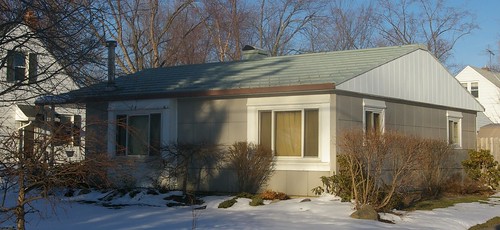
The Lustron house was a prefabricated enameled steel house made in Columbus, Ohio, between 1948 and 1950. The design was an attempt to repurpose factories left from the war effort and to address the post-war housing crisis. Approximately 2000 were made. Many were built in the Cleveland area.

All of the major component parts were made from steel - including the roof. Sadly, most have not held up as well as this model, at 695 McKinley Avenue, in Bedford, Ohio. Even it, however, has recently had replacement windows installed.
This house, documented by the Historic American Buildings Survey, provides some idea as to the original appearance of the interior. The rooms featured built in closets and cabinets, which provided greater use of the available floorspace.
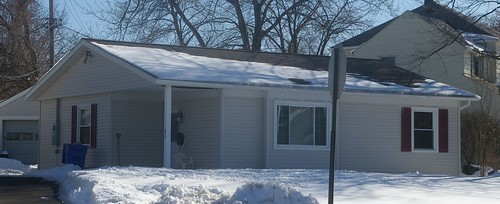
Four choices of exterior colors were available: blue, yellow, tan, and gray. Due to changing tastes, more than half of the Lustron houses in this area have since been vinyl-sided, such as this one, at 1517 Crestwood Road, in Mayfield Heights, Ohio. It seems likely that this is more the result of changes in taste than anything else - I have not seen one bit of rust on any of these houses, and if rust was such a problem that some owners vinyl-sided their houses to conceal it, it would surely show up to some extent those not vinyl-sided.
The roof, too, has been covered with asphalt shingles. It is not clear whether this was done to remedy a problem or due to changes in taste. It seems that a greater percentage of these houses have new roofs than have vinyl siding.
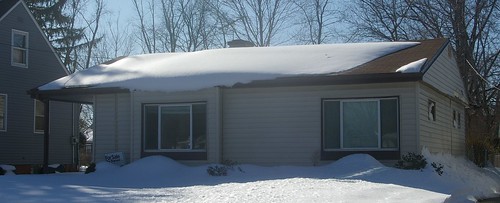
Many of the interiors have remained the same, as the steel structure makes them difficult to change. This one, however, at 1024 Mayfield Ridge Road, in Mayfield Heights, Ohio, has changed quite a bit. It is currently listed for sale by owner. The listing provides a detailed view of the interior.
These houses represent a significant point in our industrial growth and movement to the suburbs. The first enamel-steel house was built in South Euclid, by Ferro Corp. Later work in this field was based on that house.
Should we try to preserve all of these houses? No. We should work to preserve the best examples. One example would be this one, on Mastick Road in North Olmsted. It retains most of the original exterior details and looks quite sharp.
Further, we should identify all of the extant Lustron houses, so that if one is to be demolished, some of the parts, which are quite difficult to find, may be reused in other Lustron homes. Lustron Preservation has a database mapping all the known Lustrons, which provides a great deal of assistance, to that end.