Showing posts with label 1915. Show all posts

Friday, December 18, 2009

Cleveland: Home to the most attended baseball game


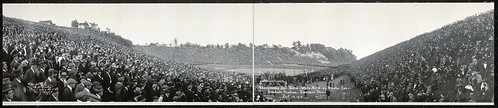
I was browsing through the American Memory collection at the Library of Congress when I came across this series of five panoramic photographs of baseball games in Cleveland. Three are from a 1915 championship game between the White Autos and the Omaha Luxus. Another shows a 1915 game between the White Autos and Johnstown, PA. Still another shows a 1914 game between Telling's Strollers and Hanna's Cleaners.

The October 10, 1915 game between the White Autos and the Omaha Luxus is especially notable due to the high attendance. Click through to the higher resolution version to fully appreciate the size of the crowd. For this amateur championship game, the attendance was claimed to be 115,000, which, if correct, would make it the most attended baseball game ever. The White Autos won, 11-6.
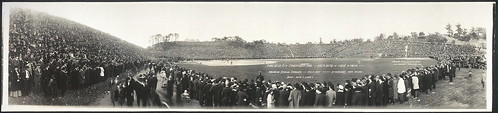
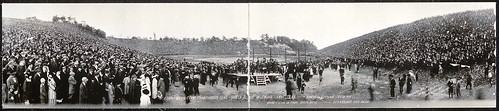


These other two images provide something of the size of the crowd. I can believe, based on these images, attendance of more than 100,000.
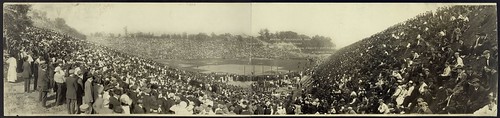


I had never heard of this stadium, so I started looking for clues as to its location. This photo, from the 1914 amateur championship game between Telling's Strollers and Hanna's Cleaners on September 20, 1914 provides more visual clues as to the shape of the ballpark and perhaps its location. The game against Johnstown, PA, however, doesn't show us much that we haven't seen already.

It seemed likely that Brookside Stadium was somewhere near the current Brookside Metropark, but where exactly was unclear. Perhaps the ballpark was in the area now used by the Cleveland Metroparks Zoo. Finally, I found the answer, in the 1922 Plat Book of the City of Cleveland. In the upper right, it shows Brookside Stadium.

The stadium shown on the map didn't seem to correspond to what I could see in the photographs. I looked at Bing maps aerial photographs of the site, and much to my surprise, I saw that there was still a baseball diamond there! The topography of the space is relatively unchanged - it still has the nice "bowl" shape that makes it a perfect stadium. There are now trees growing on the hills, but other than that, the shape of the land remains much as it was in 1915.

The stadium is located just south of Denison Avenue, between Fulton Road and West 46th Street. The diagonal line of people in the outfield in the first and fourth photographs is Fulton Road, from the time before it had a high-level bridge over the valley.

The Omaha Luxus were an amateur team sponsored by Krug Brewery. Luxus was one of their beers.

I haven't been able to learn much about the White Autos. They were presumably an amateur team sponsored by White Motor Corp.

The Cleveland Blues, who became the Cleveland Naps in 1903, also used Brookside Park Stadium. Their name change came about as a result of the skill of second baseman Napoleon "Nap" Lajoie, probably the greatest player of his time, who was with the team from 1902 to 1914.

I'm so happy to see that this piece of Cleveland history hasn't been lost. I knew we had one important site in baseball history in Cleveland, League Park. I didn't know we had two. Amazingly, both ballparks are places where a group of neighborhood kids can play a game of ball, on the same ground that so many great players walked.

Saturday, December 12, 2009

Garfield Savings Bank

Garfield Savings Bank

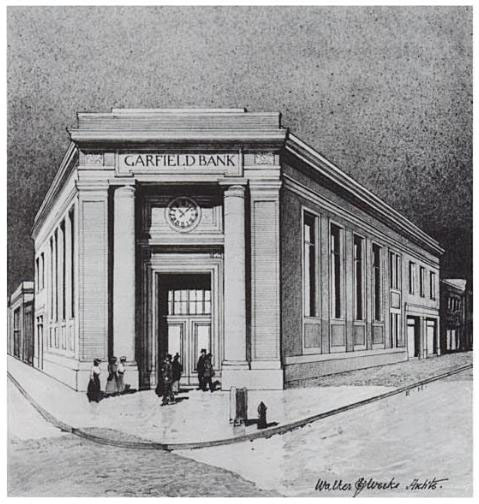
Recently, I recieved an inquiry about the history of the Garfield Savings Bank building at East 79th Street and St. Clair Avenue, in Cleveland, Ohio. It was designed Walker and Weeks, the noted Cleveland architects responsible for the Cleveland Public Library main library, the Federal Reserve Bank of Cleveland, Cleveland Municipal Stadium, Public Auditorium, and Severance Hall.

Eric Johannesen, in his authoritative work on the firm, A Cleveland legacy: the Architecture of Walker and Weeks, p36-38, says of the branch:
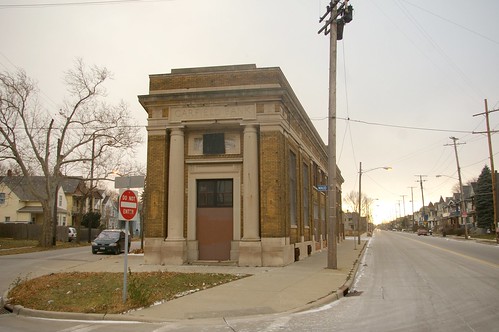
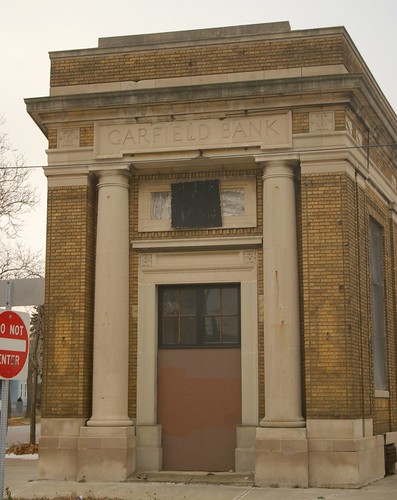
Of the many smaller banks, one of the more striking buildings was designed for the expanding Garfield Savings Bank in Cleveland, for which Walker and Weeks planned two branches in 1915. The building on St. Clair Avenue at East 79th Street stands at the triangular intersection of three streets and forms an irregular quadrilateral with the entrance at the narrow end, framed by two Tuscan columns. Like many bank buildings of the period, it incorporated space on two stories for rental as retail stores. But unlike most, it is built of brick rather than stone.


Johannasen's book also includes this drawing of the building, by Walker and Weeks.

The other branch Walker and Weeks designed for Garfield Savings Bank was on East 105th Street. According to the Cleveland Architects Database, it has been demolished.

Garfield Savings Bank

The Walker and Weeks drawing make it look like a much more evenly proportioned triangle than it is. The piece of plywood underneath the name of the bank covers what used to be the location of a clock.

Garfield Savings Bank was founded in Cleveland, on May 16, 1892. The Proceedings of the Annual Convention of the American Bankers Association for 1917 lists a main bank and four branches. The branches were located at St. Clair and East 105th Street, St. Clair and East 72nd Street, Superior and East 105 Street, and 11803 Euclid Avenue. As the address for this building is not listed, we can assume that it was probably the main branch. None of the other buildings remain.

The Fourteenth Annual Report of the Department of Banks; Fiscal Year Ending June 30, 1921 provides a detailed picture of the bank, which at the time, had assets of $17 million:


Garfield Savings Bank merged with Cleveland Trust in 1922. At the time of the merger, Garfield Savings Bank had $15 million in deposits and 66,000 depositors, according to The Bankers Magazine, vol. 104, p. 608. Property records show (AFN 192206230143) that the building was sold to Haddam Building Co. in June of that year.

Research into the Haddam Building Co. has been less than fruitful. It was founded sometime before 1906. It occupied this building until 1938, when it was sold to Ellie Barsan. In 1944, it was transferred to Virginia Barsan, who owned it until 1977. It has changed hands frequently since then.

I contacted the Photograph Department at Cleveland Public Library, which has a significant collection of photographs documenting the works of Walker and Weeks. They were unable to locate any images of this building.

Garfield Savings Bank

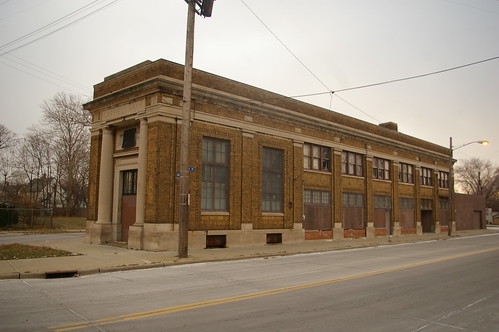
The larger windows open onto what would have been the lobby of the bank. The smaller windows, split into two stories, would have been shops with storage or apartments on the second floor. Note that the lobby is smaller than was initially suggested by the drawing above.


If you have questions relating to local history, please send them our way, either by commenting here, or by emailing them to ClevelandAreaHistory@gmail.com. We will do our best to answer them.