Showing posts with label baseball. Show all posts

Tuesday, November 15, 2011

Cleveland’s Role in Origins of Baseball in America


Since the game of baseball became an immensely popular sport in the mid-1850’s in the New York & Massachusetts region of the country, theories have existed as to when and where the game originated. The most popular theory is the Doubleday Myth, call so because it has been thoroughly debunked by great research and the discovery of prime sources that prove the theory to be a myth. Historians have exhaustively tried to solve this great mystery, and have turned up some interesting evidence over the past ten years.

Author David Block’s “Baseball Before We Knew It”, is probably the best comprehensive book on the matter. Block has discovered evidence that some form of bat and ball games were being played by the ancient Egyptians. He has discovered woodcuts of children playing bat and ball games from as early as 1301! The current general consensus is that our modern game of baseball is derived from changes in some sort of bat and ball game implemented by the New York Knickerbockers in 1845. Prior to these changes, base ball was most likely known as town ball, which is the rue American origin of the modern game. In fact, “town ball”, may have been called base ball many years prior to 1845.


In 2004, Baseball Hall of Fame Historian and noted author John Thorn discovered a reference to a ban on “baseball” in a town by-law in the town of Pittsfield, Massachusetts. The by-law was written in 1791, and was enacted to keep the game from being played within 80 yards of a new town meetinghouse built in the town. Evidently, kids were breaking windows by playing the game well over 200 years ago. Laws such as this became very common as the game became more popular. There was even a ban on ball playing in Cleveland, enacted in 1845 (see above photo). The ban reads as follows: "it should be unlawful for any person or person to play at any game of Ball, or at any other game or pastime whereby the grass or grounds of any Public place or square shall be defaced or injured." The ban was lifted in 1856.

You may ask, how does Cleveland fit into the mystery? Recent discoveries here in Cleveland corroborate what Mr. Thorn found in Pittsfield. In addition to the 1845 Cleveland ban on ball playing, which suggests that the game was popular enough to warrant a law banning it’s play in order to save countless windows around public square, I have found other references that show the game was being played here close to the same time as when the game was banned in Pittsfield.

Pittsfield, Massachusetts, is located a mere 35 miles from the Connecticut border. Connecticut claimed the Western Reserve as a territory from 1662 to 1800, and Cleveland was, and still is, by far the largest, and one of the oldest settlements in the Western Reserve. The land was settled by residents of Connecticut, and Cleveland was founded by Moses Cleaveland of Connecticut. According to an newspaper article from the Cleveland Leader from July 9, 1859, the game of baseball had been around Cleveland for quite some time.
“Baseball was a favorite game of the early settlers and we are glad to see the manly sport is still in vogue, at least in “benighted Ashtabula.” A game was played in Jefferson, and the first side to win 100 “scores” was to be declared the winner. There were 13 innings without a score. Joshua R. Giddings, 64, scored every time at bat.”

The find here is that the article ties the game in with the “early settlers”, which were people that came here in the time period of 1796 to the early 1800’s. The fact that a 64 year-old person was playing the game suggests that the game was popular, and maybe something he learned in childhood. A 64 year-old man in 1859 would have been a child during the time of settlement.

Another reference describes how the game had been around for some time in the area.

“Large crowds of men, both old and young, resort daily to the Public Square to engage in the invigorating old game of baseball. Police endeavored to stop the players on Apr. 4, but the city marshal informed the players that they were breaking no law, so playing was resumed.” (Cleveland Leader, April 8, 1857)

It is interesting to note that this game at Public Square (see above photo of ball diamond on Public Square in 1859) took place right after the ban from 1845 had been repealed in 1856! Further, that fact that again, old residents as well as young people were playing “the invigorating OLD game of baseball”, suggests that the game had been around the area for quite some time.

A final piece of evidence comes from a Cleveland newspaper article from April 15, 1841.

“Playing ball is among the very first of the ‘sports’ of our early years. Who has not teased his grandmother for a ball, until the ‘old stockings’ have been transformed into one that would bound well?… There is fun, and sport, and healthy exercise, in a game of ‘ball’. We like it; for with it is associated recollections of our earlier days.”

The article again references “early years”, and ”earlier days”. For a city that was a mere 45 years old at the time of the article, early years and days can only solidify that argument that the game was being played by the settlers of Cleveland and the Western Reserve.

A case can be made that the game of “ball”, “town ball” and/or “base ball”, was imported from Connecticut, a mere 35 miles from the earliest reference to the game in America in Pittsfield, Massachusetts. The game was cultivated, and played by our earliest settlers, who passed the pastime down to their children and grandchildren. The popularity of the game was such that the city banned its’ play in 1845 due to the same issues leading to the ban in Pittsfield in 1791 – broken windows and ruined grass. The evidence found here in Cleveland merely corroborates the theory that the great game of base ball, in some form, was being played in America for quite some time.

SOURCES:
Cleveland Newspaper Digest, 1841, 1857, 1859
Baseball Before We Knew It, David Block
Baseball Hall of Fame
Base Ball on the Western Reserve, James Egan Jr.

PHOTOS:
1845 City of Cleveland Ban on Ball Playing - ohiohistory.org
Ambrotype of Public Square in 1859, foreground shows outline of a baseball diamond
ohiohistory.org (photo of ballfield on Public Square)

Tuesday, March 29, 2011

Baseball's First Opening Day

On St. Patrick’s Day, 1871, nine base ball clubs gathered at Collier’s Pub in New York City to form baseball’s first major league, The National Association of Professional Base Ball Players. The league was comprised of all professional clubs, for the first time in baseball’s history. Prior to this historic event, clubs were mainly amateur until 1869. From 1869-1871, the National Association of Base Ball Players allowed a professional and amateur category for clubs. By St. Patrick’s Day, 1871, the professionals made a clean break from the NABBP, forming the first professional major league. Of the nine club’s Cleveland’s Forest City club was a member.


The Forest City Club, which was originally a cricket club that played at old Case Commons, was the areas prominent base ball club since the mid-1860’s. They had been members of the NABBP since they were an amateur club, and, in 1871, were entering their first season as an all professional nine. Pitcher “Uncle” Al Pratt, catcher Deacon White and Right Fielder Art Allison were their club leaders.


The Forest City Club was slated to start their season on May 4, 1871, against the Ft. Wayne Kekiongas in Ft. Wayne. However, the match was not scheduled to be the first played in the new league. That honor was slated for the Boston Red Stockings and the Washington Olympics, but the game was rained out. As a result, and though neither team knew it, the Forest City’s of Cleveland and the Kekiongas of Ft. Wayne were to be the first baseball teams to play in a major league game.

The game was played at Hamilton Field ballpark, land that once served a a Civil War camp, and was donated by Allen Hamilton. It was a rainy day, and attendance was low, with estimates of 200-500 people at the game. The match started at 3:00, and was umpired by John L. Bloake, of Cincinnati. Deacon White recorded the first hit and first double in Major League history in the league’s first at bat. He also led all players by hitting 3 for 4 from his lead-off spot. This combined with a solid pitching performance from Al Pratt were not enough for the Cleveland’s to prevail in the match. They fell 2-0 to the Ft. Wayne’s, and history was made.

The New York Herald reported on the match:

“The finest game of base ball ever witnessed in this country was played on the grounds of the Kekiongas of this city this afternoon, the playing throughout being without precedent in the annals of base ball, and the members of both clubs establishing beyond doubt their reputation as among the most perfect ball players in the United States."

The game was considered an anomaly, due to the low scoring of the match. During early baseball, it was very common for scores to be in the double digits for both sides in a match. The Fort Wayne Gazette thought the game was more significant because of the final score, than the fact it was the first major league game ever played:
“This is undoubtedly the best game on record. We know of nothing like it that has ever happened before. Just think of it, only two runs made in nine full innings!”

Cleveland’s newspapers headlines had a more familiar reaction:
“The First Dose of 1871 – A Whole Nest of Goose Eggs 0 0 0 0 0 0 0 0 0”
- Cleveland Leader

Overall, the game is a major first in baseball history, and Cleveland was a big part of it. Hopefully, the Cleveland’s will do better on Opening Day in 2011!

sources:
Base Ball on the Western Reserve, James Egan Jr.
The Baseball Almanac
National Association of Base Ball Players, Marshall D. Wright
Blackguards and Red Stockings, William J. Ryczek
Ft. Wayne Gazette
Cleveland Leader
New York Herald
Cleveland Herald

Pictures:
1st - 1869 Cleveland Forest City's - Western Reserve Historical Society
2nd - Deacon White - A.G. Spaulding Base Ball Collection
3rd - 1871 Ft. Wayne Kekiongas - BaseballChronology.com

Friday, August 13, 2010

Book Review: Base Ball on the Western Reserve

Base Ball on the Western Reserve is a comprehensive history of 19th century base ball in Northern Ohio. The book was painstakingly researched by author James Egan Jr., a Clevelander, who spent nearly 15 years combing publications and microfilm of every newspaper article in Northern Ohio for articles concerning the game of base ball. He has been called “The Indiana Jones of Cleveland Baseball”, and after you read the book, you’ll know why.

Mr. Egan not only covers the major base ball teams of the era, such as the Forest City’s, Cleveland Blues and Cleveland Spiders, but has documented local amateur clubs and games as well. His book is ordered chronologically, with chapters divided into subsections detailing any baseball events during the year. Although the book is more like an encyclopedia, Egan provides commentary, and sprinkles noteworthy vignettes throughout the scores of ball grounds descriptions and box scores.

The book is a must read for baseball historians, and includes great context for the game of base ball by detailing what was happening in the Cleveland area at the time. For example, Egan writes about how the Cleveland Blues of the National League were trained by Professor Rumsey, the self-professed “King of Excerise”, and how they trained at the Waring Block Building, which still exists today.

Egan also provides many great pictures and illustrations. For example, an opening day drawing of League Park from 1891 is in the book as well as a cartoon of the event, published in the Cleveland Press. Pictures of old Cleveland ball clubs, and 19th century base ball cards litter the book as well.

The book’s full title is Base Ball on The Western Reserve – The Early Game in Cleveland and Northeast Ohio, Year by Year and Town by Town, 1865-1900. It is published by McFarland & Company, Jefferson, North Carolina and London. It can be purchased on Amazon.com, or directly through the publisher's website.

Egan is a small business owner in Cleveland, and is working on his second publication, which will detail early Cleveland Indians baseball.

Monday, April 12, 2010

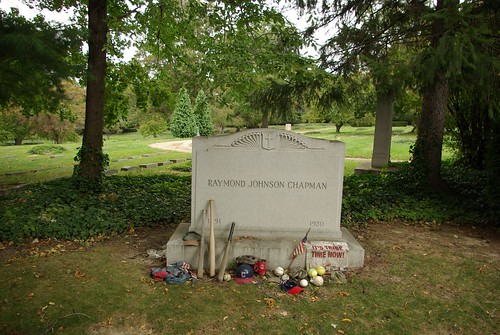
Raymond Johnson Chapman

Raymond Johnson Chapman grave marker

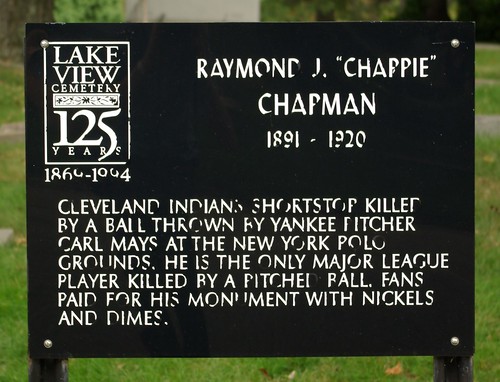
With the start of the baseball season, we remember Raymond Johnson Chapman (January 15, 1891 - August 17, 1920), the last professional baseball player to be killed by a pitched ball. The ball was thrown by Carl Mays, of the New York Yankees, at the New York Polo Grounds.

His funeral was at St. John Cathedral. He is buried in Lake View Cemetery.

Raymond J. "Chappie" Chapman historical marker

This historical marker, erected by the Lake View Cemetery Association, commemorates his life.

The Pitch that Killed by Mike Sowell documents the story behind this tragedy.

Lake View Cemetery is located between Euclid and Mayfield Roads in Cleveland. Access to the grounds may be made from either road. The mailing address is 12316 Euclid Avenue, Cleveland, Ohio.

Tuesday, February 16, 2010

Book Review: Misfits! Baseball’s Worst Ever Team

Today's guest post is courtesy of James Nickras, author of The Ohio Book Review.

Hetrick, J. Thomas. Misfits! Baseball’s Worst Ever Team. Clifton, Va: Pocol Press. (1991). 100th Anniversary Edition.

The 1899 Cleveland Spiders were the ultimate Cleveland sports team. The owners (the Robinson brothers) were loathed. It seemed like the league was against the team. The players were mostly sub-par -- and those players that were not, were traded away. 1899 was a watershed year in early baseball history in that the season led to the end of the National League-only system of “major” leagues, and opened a door for the American Association, which started in 1901. (These two leagues eventually were joined, and the only noticeable difference now is that the American League uses a designated hitter.) Every day of the Spider’s 1899 season is chronicled in Misfits!

In case you have forgotten, I will give you a brief synopsis of the 1899 season. The Spiders were a moderately successful franchise throughout the 1890s, with numerous future Hall of Famers, including Cy Young. After the 1898 season, the Robinsons purchased the St. Louis Browns and proceeded to move the more successful Spider players to St. Louis. (Yes, they owned both teams. Brooklyn and Baltimore had the same arrangement going into the 1899 season). As the season progressed, any quality players (including the Spider’s manager Lave Cross) were traded away to St. Louis, and by the end of the season, any player on the Spiders still making money was released.

Cleveland fans quickly lost interest in the team, and the Spiders (commonly referred to as the Misfits), played most of their games on the road. As could be expected, the Spiders put together a historically bad record, losing 40 of their last 41 games. To put this into perspective, let me compare the Spiders with some well knows losers: the 1962 New York Mets and the 1991 Cleveland Indians (who had the worst record of any post-WWII Cleveland team).

1899 Spiders: 20-134 (.130)

1962 Mets: 40-120 (.250)

1991 Indians: 57-105 (.352)

As a redeeming note, the St. Louis team (called the Perfectos) had a disappointing 5th place finish. At the end of the season, the National League contracted 4 franchises, including the Spiders.

I will compliment Hetrick on the painstaking research that went into Misfits!. Though much of the day-to-day information was obtained from the Cleveland Plain Dealer reporting, he verified much of the information from the opposing teams local newspaper and from other national publications. This led to many humorous observations on reporting styles or discrepancies. In an ongoing joke, the Plain Dealer mistakenly gave a loss to Frank Bates for the Spiders, though he did not pitch in the game. This error defined Bates in Misfits!. In fact, the cheap shots used by other newspapers to describe Bates’ performances make up some of the book's best humor. Poor Frank Bates! It should also be noted that the newspaper coverage was much more opinionated and harks back to a time before there was a school of journalism. Well worth checking out.

Through following the day-to-day travails of the Spiders, several stories develop. We learn of the last major league games of Louis Sockalexis, whose name is thrown around much, though he had a very brief career in Cleveland. There were also a few above-average eccentrics on the Spiders, and the book details the daily antics of Tommy Tucker and Frederick “Crazy” Schmidt. I would recommend the Participant’s Careers appendix, which includes a brief (or not so brief) biography of every player on the team.

That said, Misfits! is not for the faint of heart. Even with Hetrick’s playful humor throughout, you are still reading a day-by-day account of a team that lost almost 9 out of 10 games. How many jokes can be made about losing? Read this book and find out.

In my opinion, the book's greatest asset is the detailed portrait of how the game was played in the late 19th Century, prior to the era of the World Series. Misfits! is a document of how teams traveled, their schedule (many double headers, sometimes involving three teams), fan interaction, and how the game was covered by the local news. Yes, these aspects may have been more compelling when following a winner, but the Spiders were a historic team. And historic teams are what get remembered.

————-

The edition of Misfits! I read was published by Pocol Press. (The original publication from 1991 was by MacFarland). In doing some background research, I found Pocol Press had a wonderful bibliography of books on 19th Century Baseball. -JN

Friday, December 18, 2009

Cleveland: Home to the most attended baseball game


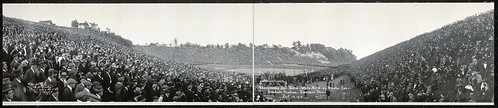
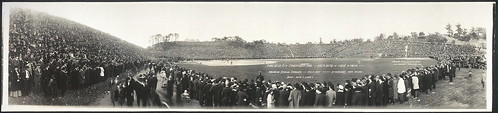
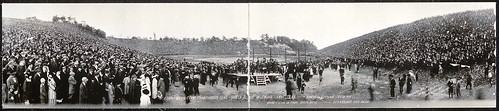
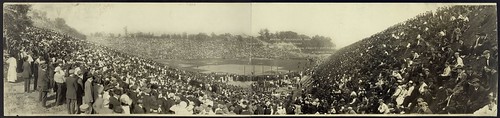
I was browsing through the American Memory collection at the Library of Congress when I came across this series of five panoramic photographs of baseball games in Cleveland. Three are from a 1915 championship game between the White Autos and the Omaha Luxus. Another shows a 1915 game between the White Autos and Johnstown, PA. Still another shows a 1914 game between Telling's Strollers and Hanna's Cleaners.

The October 10, 1915 game between the White Autos and the Omaha Luxus is especially notable due to the high attendance. Click through to the higher resolution version to fully appreciate the size of the crowd. For this amateur championship game, the attendance was claimed to be 115,000, which, if correct, would make it the most attended baseball game ever. The White Autos won, 11-6.


These other two images provide something of the size of the crowd. I can believe, based on these images, attendance of more than 100,000.


I had never heard of this stadium, so I started looking for clues as to its location. This photo, from the 1914 amateur championship game between Telling's Strollers and Hanna's Cleaners on September 20, 1914 provides more visual clues as to the shape of the ballpark and perhaps its location. The game against Johnstown, PA, however, doesn't show us much that we haven't seen already.

It seemed likely that Brookside Stadium was somewhere near the current Brookside Metropark, but where exactly was unclear. Perhaps the ballpark was in the area now used by the Cleveland Metroparks Zoo. Finally, I found the answer, in the 1922 Plat Book of the City of Cleveland. In the upper right, it shows Brookside Stadium.

The stadium shown on the map didn't seem to correspond to what I could see in the photographs. I looked at Bing maps aerial photographs of the site, and much to my surprise, I saw that there was still a baseball diamond there! The topography of the space is relatively unchanged - it still has the nice "bowl" shape that makes it a perfect stadium. There are now trees growing on the hills, but other than that, the shape of the land remains much as it was in 1915.

The stadium is located just south of Denison Avenue, between Fulton Road and West 46th Street. The diagonal line of people in the outfield in the first and fourth photographs is Fulton Road, from the time before it had a high-level bridge over the valley.

The Omaha Luxus were an amateur team sponsored by Krug Brewery. Luxus was one of their beers.

I haven't been able to learn much about the White Autos. They were presumably an amateur team sponsored by White Motor Corp.

The Cleveland Blues, who became the Cleveland Naps in 1903, also used Brookside Park Stadium. Their name change came about as a result of the skill of second baseman Napoleon "Nap" Lajoie, probably the greatest player of his time, who was with the team from 1902 to 1914.

I'm so happy to see that this piece of Cleveland history hasn't been lost. I knew we had one important site in baseball history in Cleveland, League Park. I didn't know we had two. Amazingly, both ballparks are places where a group of neighborhood kids can play a game of ball, on the same ground that so many great players walked.