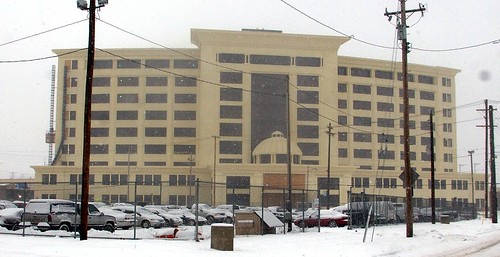
By now, you've probably heard about the new Cuyahoga County Juvenile Justice Center, under construction at the southeast corner of Quincy Avenue and East 93rd Street, in the Fairfax neighborhood of Cleveland. Little has been said, however, about the previous uses of the site.
In 1906, the Peerless Motor Car Company, one of the finest manufacturers of automobiles in the country, built a factory on this site. Architect J. Milon Dyer designed the factory. Dyer was also responsible for the Cleveland Coast Guard Station, the Cleveland City Hall, the Tavern Club, and the Brown-Hoist building.

The factory, seen here in an early 20th century view, stretched all the way to Woodland Avenue. While the portions of the factory between Quincy and the train tracks have been demolished, some structures remain between the tracks and Woodland.
The following photographs, created by the Historic American Buildings Survey, illustrate the history of this complex.

1979, Jet Lowe for the Historic American Buildings Survey
The factory's office building, shown here, faced Quincy Avenue. Dyer's work on the structure received considerable praise.
Its "front of attractive design" showed the influence of Frank Lloyd Wright in its geometric stone ornament and globe-capped pylons and of the Art Nouveau in its metal and glass entrance canopy and doors. Architecturally, the office building was "25 years ahead of its day."

February 28, 1966, Martin Lindsey for the Historic American Buildings Survey
The aesthetic quality continued to the interior. The Art Nouveau influence is especially visible in the railing on this set of stairs.
In 1931 Peerless closed its business, unable to find a market for luxury cars during the depression. The business was reorganized and eventually became the Carling Brewing Company. The automobile factory was repurposed as a brewery, which operated until 1971. C. Schmidt & Sons, purchased the brewery and ran its operations from the plant from 1972-84.
Most of the complex was demolished in the late 1980s or early 1990s. The Historic American Buildgs Survey has two sets of documentation regarding the factory. Their documentation addresses the history of the structure and of the Peerless operations in Cleveland in detail.