Last week we challenged you to sum up Cleveland's identity in 200 words or less. Before we post your responses, here is my own contribution:
Cleveland’s identity begins with the Western Reserve -- and may end with it, given recent talk of regionalism and “Cleveland+”. Without the Connecticut Land Company surveyor Moses Cleaveland, we wouldn’t have a name. Without that link to New England, we wouldn’t have a Public Square.
Cleveland’s identity is inextricably connected to the Cuyahoga River, which made us ideally suited to be the main port linking the Great Lakes to the Ohio River via the Ohio and Erie Canal. Like the East, we experienced an influx of European immigration during the late 19th and early 20th centuries. Like the rest of the North, we experienced the Great Migration of African Americans from the South during the years 1910-1940.
We prospered and grew and developed world-class cultural institutions.
We built a lot of things here, and now, not so many. Like it or not, Cleveland is part of the Rust Belt, but it’s important to remember that unlike many of the small towns that popped up as a direct result of the American manufacturing boom, we were already sitting on nearly 200 years of history when things started to fall apart. If we have to fall, we’ve got good cultural bones to fall back on.
Still want to submit your own 200-word interpretation of Cleveland's historic identity? Email us at clevelandareahistory [at] gmail [dot] com.
Friday, January 29, 2010

Thursday, January 28, 2010
Lost: Hathaway Brown School and Laurel School

Image courtesy of the Cleveland Memory Project
Yesterday, the Cleveland Clinic demolished one of the last vestiges of the once great Euclid Avenue, an impressive dark sandstone building at 1945 East 97th Street, designed by architects Hubbell and Benes for Hathaway Brown School in 1905. The school used this building as its home until 1927, when it moved to Shaker Heights. Some of the firm's other notable commissions include the West Side Market, the YMCA, and the Ohio Bell Building.

The Clinic will soon, probably today or tomorrow, demolish another building in the complex, the home of Laurel School from 1909-1928.

This is all that remained yesterday of the Hathaway Brown building. It is shameful that the Cleveland Clinic was unable to find an adaptive reuse for this historic structure. They've done an excellent job of repurposing the 1901 Henry P. White house, at 8937 Euclid Avenue. Surely they could have found a use for this structure of similar character.
It has become clear that the Cleveland Clinic has little regard for the history of the area that has supported it and helped it grow. The last major building the Clinic demolished, the Ohio College of Podiatric Medicine, is now surface parking. While the need for parking is clear, I, for one, would be in favor of zoning variances allowing larger parking garages if it would guarantee the Clinic would save some of these buildings.
Take another look at the Cleveland Play House. Is there any doubt that the Cleveland Clinic will demolish the structure as soon as they take ownership of it?
I encourage you to contact the president and CEO of the Cleveland Clinic, Delos Cosgrove, M.D., to let him know your feelings on this subject. He can be reached by phone at 216-444-2300 or by mail at:
Delos Cosgrove
Cleveland Clinic Main Campus
Mail Code H18
9500 Euclid Avenue
Cleveland, OH 44195
Monday, January 25, 2010
The First of Cleveland's Follies?

It’s true. Throughout our history, Cleveland has made some mistakes. Maybe a few more than our fair share. So could this elaborate mansion built by Samuel Andrews and vacated by his family after having been lived in for only three years, have started it all?
In 1874, during Cleveland’s most prosperous time, John D. Rockefeller bought his partner Samuel Andrews out of the Standard Oil Company for $1 million due to their irreconcilable differences. Andrews had been hailed as an extremely capable mechanic and chemist. He developed the method to extract kerosene from crude oil, which is how he came to be in business with Rockefeller and subsequently assist in the formation of the Standard Oil Company.
Andrews rose from near poverty into his newfound stature of wealth. Apparently he took the wealth and ran with it, living a rather grandiose lifestyle. He and his family lived on Euclid Avenue at East 28th Street when he made a deal to switch properties with William Bingham Sr. and planned the construction of his massive 18,000 square foot English Gothic mansion at the northeast corner of Euclid Avenue and East 30th Street. Today this is the site of the WEWS property.
Each of Samuel Andrew’s seven children had their own room, and the home was apparently the first in Cleveland to have an elevator, which ran from the basement to the third floor. The home took three years to build, was lived in for three years, and then left vacant but fully furnished for 30 years. Apparently the logistics, layout, and maintenance costs of the home were not properly planned for and became quite a burden on both the family and staff of the home. Andrew’s dream of entertaining Queen Victoria (England was his country of origin) never came to be. This photo on the Cleveland Memory website shows the home up for sale in 1917.

The city’s Landmarks Commission website notes Walter Blythe as the architect for the structure, which coincides with Jan Cigliano’s Showplace of America: Cleveland’s Euclid Avenue, 1850-1910. This book is a must read if you enjoy learning about Millionaire’s Row. However in one sentence of this book, George H. Smith is noted as the architect, which matches the notation in The Encyclopedia of Cleveland History. I plan to research this further to find the correct information.
Overall it appears that this structure and its fate was a result of the desire for maximum opulence. Form and function, however, must work hand-in-hand.
Friday, January 22, 2010
What Cleveland Needs in 2010: An Identity
Cleveland Memory Project director Bill Barrow has suggested that what Cleveland really needs is an identity. Something that incorporates its historic roots, its evolution, and its potential. A tall order, to be sure -- one that can’t fit onto a bumper sticker. An identity shouldn’t fit on a bumper sticker, anyway. An identity is fundamentally different from a marketing slogan, such as The Best Location in the Nation, or a brand, such as CLE+.
Now don’t get me wrong -- marketing is vital to a city’s economic success. But Cleveland can’t find itself solely through the trumpeting of its positive attributes -- no matter how positive they are. It’s like casting a blind eye to your kid’s obnoxious nose-picking habit because, well, he’s your kid, and isn’t he precious? In pop psychology terms, it’s the difference between building up self-esteem and encouraging self-actualization.
Understanding the city’s past is vital to constructing its identity. So the next logical step after a good, hard round of civic self-exploration is the construction of a cohesive civic identity. Something that won’t exactly fit on a bumper sticker, but could be summed up in 100-200 words.
Anyone care to give it a try? Email us at clevelandareahistory [at] gmail [dot] com and we’ll post some of our favorite responses. (We’ll try our hand at it, too!)
Now don’t get me wrong -- marketing is vital to a city’s economic success. But Cleveland can’t find itself solely through the trumpeting of its positive attributes -- no matter how positive they are. It’s like casting a blind eye to your kid’s obnoxious nose-picking habit because, well, he’s your kid, and isn’t he precious? In pop psychology terms, it’s the difference between building up self-esteem and encouraging self-actualization.
Understanding the city’s past is vital to constructing its identity. So the next logical step after a good, hard round of civic self-exploration is the construction of a cohesive civic identity. Something that won’t exactly fit on a bumper sticker, but could be summed up in 100-200 words.
Anyone care to give it a try? Email us at clevelandareahistory [at] gmail [dot] com and we’ll post some of our favorite responses. (We’ll try our hand at it, too!)
Tuesday, January 19, 2010
The Edward F. Dyer residence
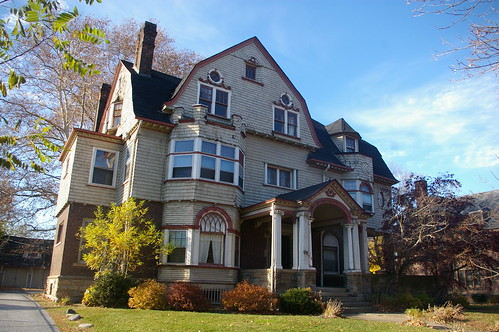
Back in November I posted a piece on the East 89th Street Historic District, a National Register of Historic Places Historic District, in Cleveland, Ohio. I lead with a picture of this house. At time, I referred to it simply as 1834 East 89th Street. Imagine my delight when I came across the following photo in Art Work of Cleveland (1911) in the Cleveland Public Library digital image collections.
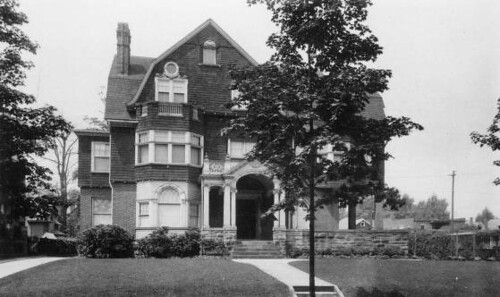
It is surprising how little the house has changed in the past hundred years. Usually, it is difficult to maintain a house with this level of detail. If we look closely at the photograph, there are only two areas where significant changes are obvious.
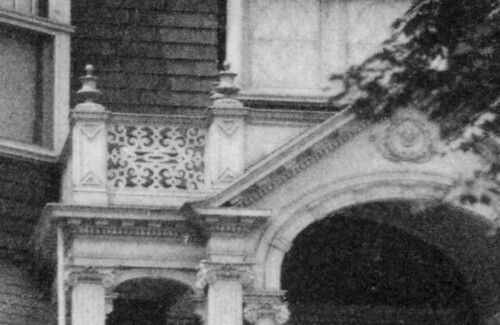
Over the front entryway, an ornate railing was originally present.
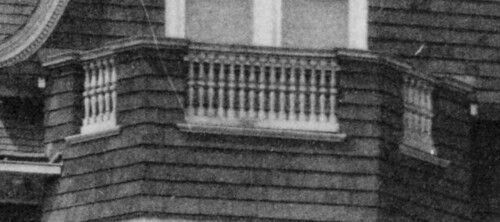
A more simple railing was also present on the third floor, over the "tower".
It seems likely that these two railings were removed due to difficulty of maintenance and decay.
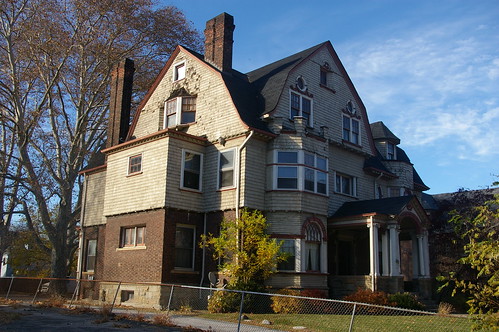
Overall, as mentioned above, the house is remarkably well preserved. Even the downspouts for the gutters are in the same location as the originals.
The above citation, by listing the owner at the time of the pubication, gives us a start in learning something of the history of the house.
According to the Cleveland Necrology File, Edward F. Dyer, born in 1859, died in this house at 9 AM on Monday, May 7, 1923. He is buried in Lakeview Cemetery. He was the father of Herrick (or Harold) H. Dyer.
Edward F. Dyer was the son of Ebenezer Herrick Dyer, who established the first commercially viable sugar beet mill in the United States. A historical marker in Union City, California, commemorates the site of the factory, on Byer's farm. Edward would go on to be an inventor and engineer for his father's company.
The Builders of a Great City: San Francisco's Representative Men states "To the perseverance and pluck of Mr. Dyer, and the efficient assistance rendered by his son, Edward F. Dyer, who by his scientific and practical knowledge has made valuable improvements in the method of treating the juice of the beet, the industry in this country owes its existence to-day."
As of 1880, Dyer was still living with his parents, in Alameda, California and working as a secretary for the Best Sugar Co.
The E.H. Dyer Co. had moved to Cleveland by 1901. Their offices were in the New England Building, on Euclid Avenue. The Sugar Beet Gazette refers to them as "the pioneer builders of beet sugar factories."
Edward authored the 1903 book Designing, engineering, contracting, operating complete beet sugar plants.
The 1910 Federal Census indicates that they had two live-in maids. As of February, 1917, he was listed as being a liftime memeber of the Cleveland Museum of Art.
Subscribe to:
Posts (Atom)