Showing posts with label glass plate negatives. Show all posts

Monday, September 20, 2010

The James A. Garfield Monument


Yesterday was the 129th anniversary of the death of James A. Garfield. The Garfield Monument, his burial place, in Lake View Cemetery, is one of our most grand public structures.

These images illustrate the Garfield Monument at the turn of the century. The photographs are from 8x10 glass plate negatives, created by the Detroit Publishing Co.. The originals have been scanned at high resolution and made available online by the Library of Congress.


Note that, in these photographs, the stone of the monument appears to be of a much lighter color. The dark color we associate with the structure is likely the result of decades of pollution. Originally, it was probably a lighter tan.


The processional nature of the roads leading to the monument is more obvious here, as it is not obscured by trees. This provides some hint as to the original landscaping plan of the site. I do not mean to suggest that the trees now present should be removed - my intent is just to show that these aesthetic perceptions have changed over time.

The Library of Congress has a couple more photographs from this series.

Wednesday, August 11, 2010

The Schofield Building revisited

Schofield Building

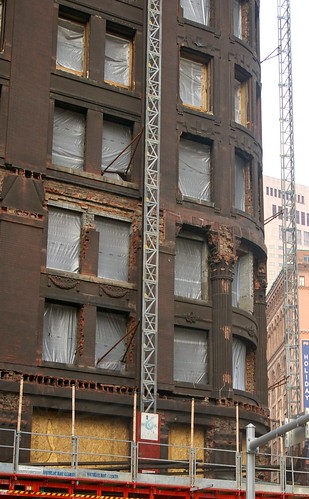
Back in May, I wrote a post about the restoration of the Schofield Building. The terra-cotta-faced skyscraper had long been covered by a steel and glass facade. The current owners are in the process of restoring the exterior. Unfortunately, at the time, I was unable to provide a good image of what the building used to look like.


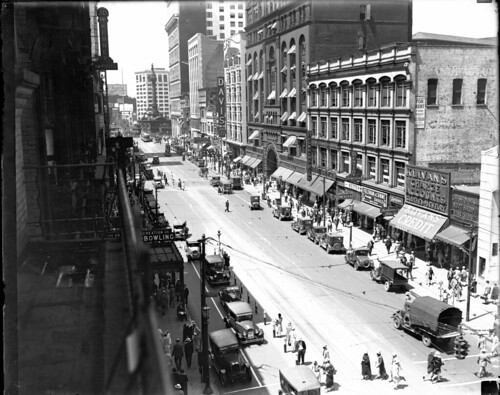
A few days ago, I came across this image, a photograph of Euclid Avenue made on an 8x10 glass plate negative, from the Detroit Publishing Company Photograph Collection in the Library of Congress.

The Schofield building is seen to the far left in this photograph. The Library of Congress has been kind enough to scan the negative at ultra-high resolution, so if you want to see more detail, click through to their website for the really detailed version.

Tuesday, August 10, 2010

Cleveland in 1927, part 4

I recently obtained ten 4x5 glass plate negatives of Cleveland scenes, taken in 1927. Thanks to the assistance of Bill Barrow, Special Collections Librarian at Cleveland State University and Joanne Cornelius in the Digital Production Unit there I was able to get the negatives digitized at 1200 dpi. This provides a very high resolution look at these parts of Cleveland. Be sure to click through for the highest resolution versions of the files.

In the first post in this series, I shared a few scenes that were reasonably familiar - the Terminal Tower, the Arcade, and Public Auditorium. In the second post, I shared two views of Central Avenue (now Carnegie Avenue) at East 14th Street. In post three, I continued the journey west on Central Avenue. In this, the last post in the series, I share two more view of Central Avenue as well as one that provides a fitting close.
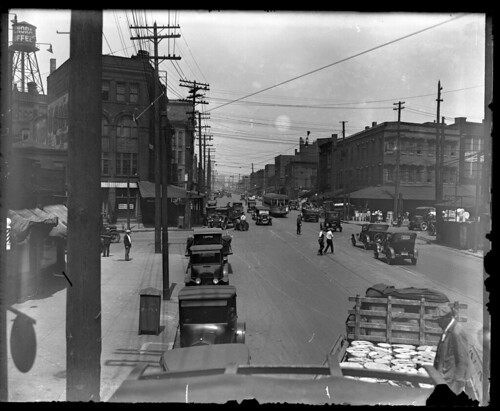
Central Avenue at Woodland Avenue, looking west

For this image, the photographer was looking southwest on Central Avenue (now Carnegie Avenue). In the foreground, to the right, is the intersection with Woodland Avenue. In the midground, Broadway Avenue crosses Central. In the background, Ontario Street intersects with Central. In the version of this image on Flickr, I've noted all these items.

Here we see, on the left, the building with the large awning, seen on the right in the last photograph of the last post. Behind it is the ornate Broadway Hotel, advertising steam heat and rooms at 50 cents, 75 cents, and $1.00.

Behind the Broadway Hotel, we can see several billboards. One advertises Cleveland Wallpaper Cleaner. Another, for a Studebaker, lists the price as $1335. A third is for Lucky Strike cigarettes.

In the background, at Ontario Street, we see an interesting almost-triangular building, which was demolished to make way for the Lorain-Carnegie Bridge.

On the right side of the street, at Woodland Avenue, stands the OK Hotel, advertising beds for 25, 30, and 35 cents. The sign noted that they had free shower baths. Note the building behind it that is three pairs of windows wide.
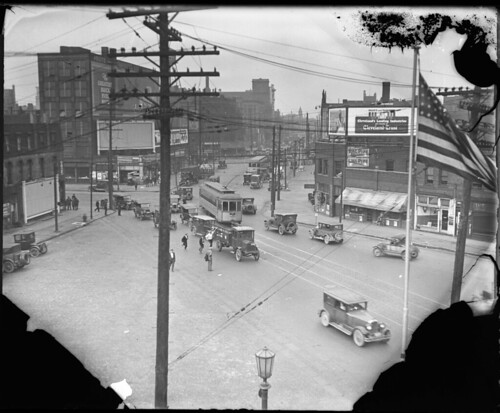
Central and Ontario (looking northeast)

In this photo, the building that is three pairs of windows wide, as noted above, is seen, from the opposite side. Here, the photographer is looking northeast down Central Avenue. Ontario Street intersects with Central in front of the aforementioned building. Behind it, Broadway Avenue intersects with Central. We can see a sign on the building advertising "the greatest Buick ever."

On the right side of the street, a billboard for the Cleveland Trust notes that it finances "Paint and Varnish, Cleveland's Leading Industries." What else can you see here?
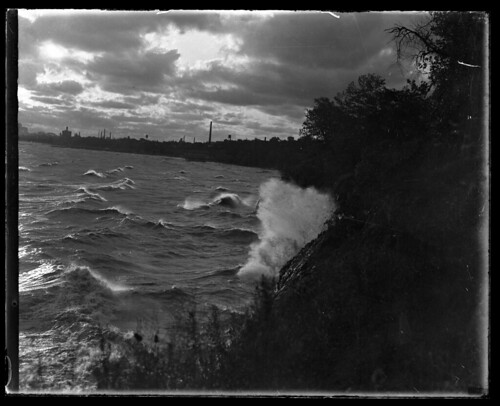
Cleveland, as seen from the Gold Coast

At first, I had assumed that this was another unidentifiable view of Lake Erie. However, the presence of the Detroit-Superior Bridge in the distance (at the far left) helps show us exactly where the photographer was standing - on the Gold Goast, looking east at downtown Cleveland.


This view, probably at sunset, provides a fitting (if slightly cliché) end to this series. I hope to share other previously unseen sets of historic photographs of Cleveland in the near future, but I need your help - I can't afford to keep buying these photographs just for the sake of providing new and interesting content.

If you have such a set of historic photos of the Cleveland area, and are willing to share them, please contact clevelandareahistory@gmail.com. I will scan them and return the originals. I'm not just interested in pictures of buildings - photos of people and of daily life are great, especially if the individuals in the photographs are identified. Your loan of the materials will help better illustrate our local history.

Wednesday, August 4, 2010

Cleveland in 1927, part 3

I recently obtained ten 4x5 glass plate negatives of Cleveland scenes, taken in 1927. Thanks to the assistance of Bill Barrow, Special Collections Librarian at Cleveland State University and the Digital Production Unit there I was able to get the negatives digitized at 1200 dpi. This provides a very high resolution look at these parts of Cleveland.

In the first post in this series, I shared a few scenes that were reasonably familiar - the Terminal Tower, the Arcade, and Public Auditorium. In the second post, I shared two views of Central Avenue (now Carnegie Avenue) at East 14th Street. In this post, we will continue southeast, looking at an area that have been completely changed by the interstate highway system and the construction of Jacobs Field.

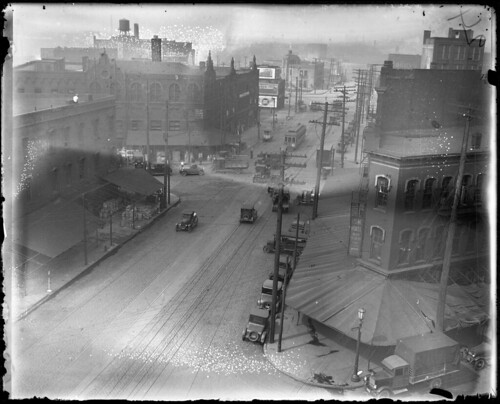
Central Avenue, looking northeast

It took me a long time to figure out where this photograph was taken. Unlike the other photographs, there weren't any obvious street signs or named buildings that are still extant. Finally, I saw two buildings in the distance that I knew - the YMCA and the Walker and Weeks building. Between the two, in the haze, one can also make out the outline of a church. From this, I was able to see that the photograph was also taken of Carnegie Avenue (at the time Central Avenue).

The photographer appears to have been on the top of a building, on the north side of Carnegie, at about East 7th Street. In the distance, the water tower and smokestacks of the Independent Towel Company are visible. Near the right side of the image, a square tower with four small domes is Acme Hall. The Hall faced East 9th Street, the intersection of which is visible in the midground.

A poster in the alley advertises a film of the fight between Jack Dempsey and Gene Tunney. On the right side of the street, underneath a billboard for Meadow Butter is the Sencabaugh Company, a grocery wholesaler.

Central Avenue, at Broadway, looking northeast

This view, still looking northeast, shows the intersection with Broadway. As a point of reference, the tower of Acme Hall is visible just behind the traffic light, in the middle of the intersection. The water tower of the coffee company that was visible in the second post can be seen here, from the opposite side. Finally, the Botzum Bros. sign that was visible in the previous photograph can just be seen above the far end of the streetcar. Note the interesting truck on the right, on Broadway, just about to pull onto (or cross) Central.

Friday, July 30, 2010

Cleveland in 1927, part 2

East 14th Street and Carnegie

I recently obtained ten 4x5 glass plate negatives of Cleveland scenes, taken in 1927. Thanks to the assistance of Bill Barrow, Special Collections Librarian at Cleveland State University and the Digital Production Unit there I was able to get the negatives digitized at 1200 dpi. This provides a very high resolution look at these parts of Cleveland.

In the first post in this series, I shared a few scenes that were reasonably familiar - the Terminal Tower, the Arcade, and Public Auditorium. This photo is the last one that will contain many obviously recognizable buildings.

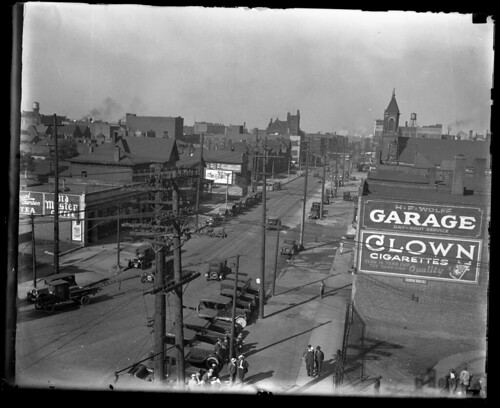
The scene shown here is of the intersection of Carnegie Avenue (then Central Avenue) and East 14th Street. The camera is pointed to the northwest.

To the left is St. Anthony of Padua Roman Catholic Church, still standing. Next to it, the May Company garage. Behind them, one can see a bit of green space - Erie Street Cemetery. Behind this row of buildings sits Brownwell Junior High School, also still standing. On the same block, we can also see H.F. Wolff's garage. In the foreground, there is a Rex gas station.

On another corner, there is a tailor, print shop, and restaurant. On East 14th Street, on the far left, is a building that for some reason continues to catch my eye, perhaps because of elements that seem almost Art Nouveau.

Central Avenue, Looking southwest

This photo shows the view west on Carnegie Avenue from East 14th Street. The sign of H.F. Wolff Garage can be seen on the right. We can also see the spires of St. Anthony of Padua. Other than that, just about all of the buildings shown here - both houses and commercial establishments - are now gone.

There are so many questions. What is the building in the distance, in the center, that looks like a church? And what enterprise was served by the distant water tower?

These photographs help to serve as a historical record of this bit of lost Cleveland. In the next group of photographs, I'll explore more of this now-lost section of Carnegie Avenue.

Wednesday, July 21, 2010

Cleveland in 1927, part 1

I recently obtained ten 4x5 glass plate negatives of Cleveland, taken in about 1927. They appealed to me because they were personal photographs, so they weren't the same images that I've seen reproduced many times before. Some were of areas that I haven't really seen photos of. Further, the large size of the negatives means that they contain a heck of a lot of information. This includes street signs, billboards, and signs in store windows.

I want to thank Bill Barrow, Special Collections Librarian at Cleveland State University and the fine folks in the Digital Production Unit for helping me to identify the locations in these images and getting them digitized.

The negatives were scanned at 1200 DPI, which brought out almost all of the information they had. I strongly encourage you to click through full-resolution versions of the files on Flickr, to see all the detail.

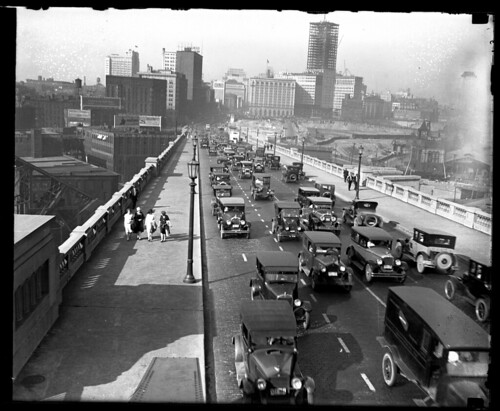
Downtown Cleveland, seen from the Detroit-Superior Bridge

This image, taken on the Detroit-Superior (Veterans Memorial) Bridge shows the Terminal Tower under construction. The bridge to support the train tracks going into the terminal can be seen to the right, under construction. One can also see the Baltimore and Ohio railroad terminal, to the far right, at a time before it had lost its mansard roof. There are many signs identifying businesses as well as billboards.

It's interesting to note that the photographer appears to have climbed up on the steel arch of the bridge to take this photograph.

Euclid Avenue

This photo shows Euclid Avenue, looking west toward Public Square. The Soldiers and Sailors Monuement can be seen in the distance. The Loews Mall theater was showing Rod La Rocque in Resurrection, allowing us to date the image to 1927, the year that film was released. All sorts of other illuminated signs line the street, including those for clothiers and dentists.

Police officer and horse

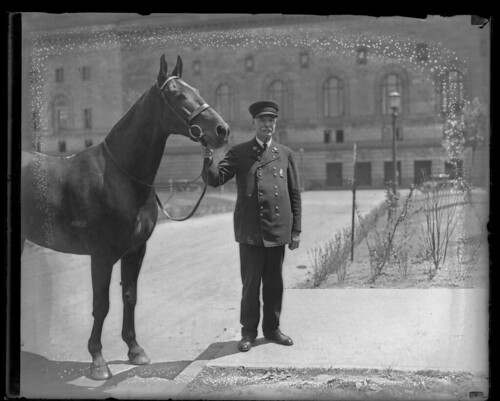
Finally, I offer you a mounted firefighter and his horse. They are photographed in front of Public Auditorium. This was about the time when the fire department became fully mechanized, so this may well have been the last horse in their service.


Check in for our next post, where we look into a few more of these photographs.