Showing posts with label planning. Show all posts

Tuesday, October 5, 2010

The New Cuyahoga: A Proposal to Straighten the "Crooked River"

The name Cuyahoga is said to mean "Crooked River". Yet in the 1910s, there was a proposal to straighten the river, The New Cuyahoga: River Straightening Recommendations. This document was brought to my attention by Kevin Leeson, of the Cuyahoga County Planning Commission. The book is reproduced here from a copy in their collections, with the exception of the map below, which is used courtesy of Special Collections, Cleveland State University.


Image used courtesy of the Cleveland Memory Project, Michael Schwartz Library, Cleveland State University

The publication includes this folded map. (Note: a higher resolution version, as well as other maps of the river, are available as part of the Cuyahoga River Online Exhibition.) The blue represents the current course of the river, while the red represents the proposed realignment. Why would the Committee on River and Harbor Improvement of the Cleveland Chamber of Commerce, the author, suggest this? Why would they suggest the drastic change to something that was for a long time, one of the more graphically recognizable elements of our city?

In short, commerce. The report suggests that the difficulty of navigating the river made shipping to and from Cleveland more expensive, putting the port at a commercial disadvantage. Further, it was said that the project would provide relief from the flooding of the Flats, as had happened in 1904 and 1913. It suggests that the money saved by preventing floods would cover the cost of the river realignment. The authors add that it would open part of the upper Cuyahoga to industrial development.

A 1919 report, Conservancy and the Cuyahoga continues on the same train of thought.

It's unclear why these proposals remained mere proposals. The shape of the river remains an important part of Cleveland's history - from its founding to industrial growth to now, when we're using it for recreation - it's even a part of the Cleveland Area History logo.

There's no mention as to whether they planned to change the name of the river, once it was no longer "crooked".

Monday, October 4, 2010

Condemned Cleveland: A House on South Boulevard

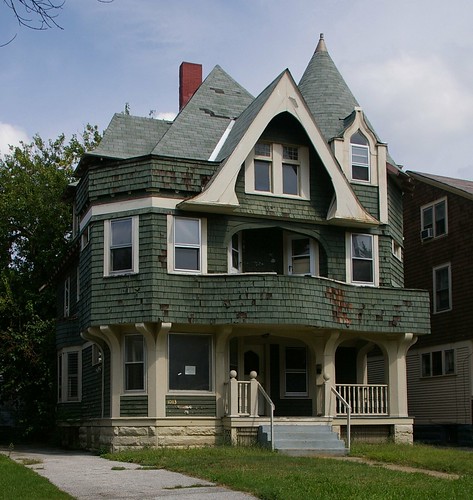
House in Wade Park neighborhood

A little while ago, I shared the list of structures condemened by the city of Cleveland in the past six months. I've been going through the list as I'm able, identifying the structures I that appear to be most historically or architecturally important.

It's a lot of structures. As of right now, the number is about 1200. And it's an imperfect science - I'm using Google Street View and Bing Maps to see what I can - but this is limited. Yes, I'd prefer to actually set my eyes on these properties, but I simply don't have the time. Further, I don't have a good list of which properties might be important for what happened in them.

Take a look at the list. See if there's anything in your neighborhood that you think is important. If you can get me photos of them, it would be much appreciated.


The lead photo is of 10113 South Boulevard, Cleveland, Ohio. It's one of the more interesting houses in the East Boulevard / Wade Park area - a neighborhood of eclectic homes. I wrote a story on it back in November - this was one of the houses included in that story.

The property was sold at Sheriff's Sale in July, 2008, to the mortgage holder, Wells Fargo Bank. Property taxes appear to not have been paid since that time. In December of that year, it was sold to the current owner, Ez Access Funding, LLC.

EZ Access Funding owns more than 70 properties within the city of Cleveland. As of September 30, they have been prohibited from transferring any property in Cleveland, for their failure to appear in court. (AFN: 201009300961)

EZ Access Funding, LLC is registered in California. Its mailing address is listed (by the California Secretary of State) as 3920 Birch Street, Suite 105, Newport Beach, CA, 92660. Their contact agent is one Marc R. Tow, a lawyer, whose mailing address is 3900 Birch Street, Suite 102, also in Newport Beach. Their phone numbers are 949-419-9093 and 949-975-0544, respectively.

This would be the same EZ Access funding who owns the house that exploded on West 83rd Street. Bill Callahan discusses their questionable business dealings in much more detail. Marc Tow / EZ Access were scheduled to appear in Housing Court back in February, to address several matters, including almost $100,000 in back taxes and an outstanding warrant, but to no one's surprise, they did not appear.

How much damage must an individual do before we can justify the cost of sending a bailiff cross country to serve them? Surely there must be something that we can do to address parties who, through apparent negligence, damage the historic structure of our communities and diminish our tax base.


This beautiful turn of the century house deserves a better owner. The architectural character contributes to the historic nature of the neighborhood.

East Boulevard is a great neighborhood - and I'm not just saying this because I work in it (at the Langston Hughes Branch of Cleveland Public Library). Surely this property could be sold at sheriff's sale to the city land bank - and then to the new owner - if there was someone interested in fixing it up. It's a great property - perhaps you are that person?

Check in on Wednesday for the next article in this series. Until then, take a look at the list and see if there is anything that catches your eye.

Update: October 5, 2010: I looked in the first floor windows. Through the front door, you can see a fireplace with built in benches on either side. To the left, one can see a doorway with a pair of pocket doors. To the right, just inside the door, is a small built-in bench. Next to it, the stairs up the the second floor. The woodwork is beautiful. It's the cleanest condemned house I've yet seen.

There are a few liabilities. I saw some damage to the plaster by the pocket doors (looked more like vandalism than a search for plumbing). The kitchen was a rather boring replacement - but in decent condition. The exterior did show some water issues, which appeared to be due to the lack of gutters and downspouts on the structure.

Friday, September 24, 2010

Which Cleveland structures have been condemned?

One of the issues we face in the field of historic preservation is simply identifying the properties that are most threatened. Some threats include neglect, redevelopment, and vandalism. Here, right now, the greatest threat is from the Cleveland Department of Building and Housing, in the form of demolition used as a tool to abate housing code violations.

How and why may a property be condemned? When there is probable cause, a housing inspector may obtain a warrant and search a structure for code violations. If the violations are severe enough, a condemnation notice will be issued, listing the violations - see the Stanley Block for an example. This gives the property owner a period of time, usually 30 days, to fix the violations or appeal. If the owner fails to respond or comply within the given time, the case goes to the Law Department, who reviews the case and then forwards the file to Department of Building and Housing's Demolition Bureau. The Demolition Bureau requests bids and selects a demolition contractor. Once the demolition is complete, the city bills the owner for the cost of demolition.

A condemnation notice doesn't mean that the structure will be demolished. A property owner may elect to fix the violations. It is, however, the first step on that route, and therefore, the best time to act. The problem is knowing which historic structures have been condemned.

The only public notice currently provided are signs stapled to the exterior of the structures. These are often removed or fall off. While one can keep track of a few important properties, and others will notice some, as was the case where one of you let me know about the Frankie Yankovic boyhood home, this just isn't sufficient. It would be a massive, time-consuming task to identify all of these structures. We can do better.

To that end, I requested a list of the structures that had been condemned in the past six months from the Department of Building and Housing. I said that if that list wasn't available, I'd take whatever data they might have that would include the condemnations. I received this list. It lists all 1202 properties condemned between April 1 and September 21, 2010. Look at it. See if there are any that you know to be important.

Note: At present, one cannot sort the list by street. I had tried to split up the addresses so that this could be done, but for some reason, it led to errors in the column for type of condemnation. I will work on this. Update: October 4, 2010: the data can now be sorted by address. Also note that the two far right columns are my own notes. I'm trying to figure out which structures are important, both for history and aesthetics. As you can see, I need help.

A further note on my notes:
H = Historic
m = Maybe historic
n = Not obviously historic. May still be a very interesting house or have historic value not obvious on the surface - i.e. the residence of a famous person.
? = I can't see enough from the available aerial photos to make a judgement one way or the other.
i = Architecturally interesting. Not of major historic value, but of above average quality and probably worth preserving.


To better illustrate which structures have been condemned, I've used a map here to display the data. Which historic sites do you see?