Thursday, October 7, 2010

Mystery Photo for October 7, 2010

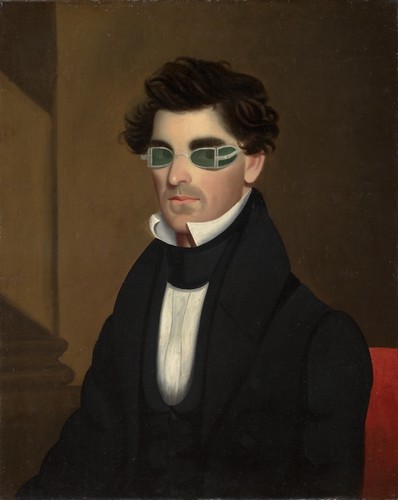
Sally Avery Olds

Do you know who this is a painting of or why it is significant?

Peter Buettner correctly identified this painting as Sarah Avery Olds, painted by Jeptha Homer Wade. It's in the collection of the Cleveland Museum of Art. It's one of a pair - and you're much more likely to have seen the other half of the pair, also in the Cleveland Museum of Art.

Nathaniel Olds

The couple were painted in 1837. Nathaniel wears the glasses, for which his portrait is so well known, to protect his eyes from the extremely bright light of whale oil lamps, which was thought to be harmful.

The artist, Jeptha Homer Wade, would give up painting and go on to found the Western Union Telegraph Company.

Be the first to identify it in the comments here or on our Facebook page and win your choice of the following books:
  • Covering History: Revisiting Federal Art in Cleveland, 1933-43, a beautiful, 72 page joint publication of the Cleveland Artists Foundation and the Cleveland Public Library. It picks up where Karal Ann Marling's work (Federal Art in Cleveland) left off, and is highly recommended.
  • Any of the other publications of the Cleveland Artists Foundation that are still in print. The CAF is the organization publishing works on the history of art in greater Cleveland.
  • Shaker Heights Fences by Patricia J. Forgac (1984, 16 pages)
  • Shaker Heights: the Van Sweringen Influence by Claudia R. Boatwright (1983, 56 pages)
Guesses may be made either as comments on this post or as comments on the corresponding post on the Cleveland Area History Facebook page. If you are unable to comment here, you may want to try commenting using your name and email instead of logging in to Blogger via some other account. Hints will be given as they are merited. If you publish books or other products relating to Cleveland history and would like to offer them as prizes, please email clevelandareahistory@gmail.com

Wednesday, October 6, 2010

Condemned Cleveland: An Update

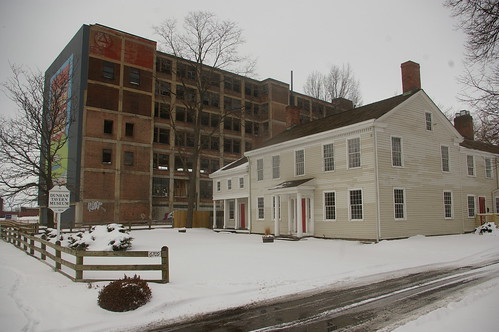
Dunham Tavern

As you may have noticed, a link to the list of properties condemned in Cleveland (since April 1) has been added to the sidebar titled "Information You Need". It has been updated through October 3. Future updates will be posted as they become available. It can now be sorted by street. As I noted before, being condemned does not mean that a structure will be demolished - rather, it is the first step in the process that leads to the demolition of a structure - and the best time for us to act.

I've now gone through the list, some 1500 entries, using Google Street View and Bing maps aerial photographs and tried to identify the most significant properties. For a full detailing of what my notes mean, see this post. Your help is still needed to determine which, if any, of these structures were the homes of famous Clevelanders.

6611 Euclid Avenue, the structure in the lead photo behind the Dunham Tavern, is on the list. As I mentioned before, it lost its façade to the RTA's Health Line. While it doesn't have the historic importance of some structures that I've advocated for, and it doesn't have much in the way of architectural detail, I believe that it is really important.

It's the last major industrial structure remaining in this vicinity. Its massive, looming hulk provides significant historical context for the Dunham Tavern. It illustrates the direction that Cleveland took, and how what was once a rural road became the major artery for an industrial city.

The survival of the Dunham Tavern among blocks of empty lots and two or three story structures is unimpressive. When one can see what it stood up against, it is much more significant. The building is owned by the RTA - in other words, us - we'll have no one to blame but ourselves when it is demolished.

There's one more item - another condemned structure - to add to my post, Euclid Avenue: What We've Lost and What We Will Probably Lose. The former grocery store at 8400 Euclid Avenue is the only other building on the block that the Cleveland Play House stands on. It will likely be purchased by the Cleveland Clinic. The structure does not appear architecturally significant to my eyes. Rather, I mention it as a further indicator of the transition of this street.

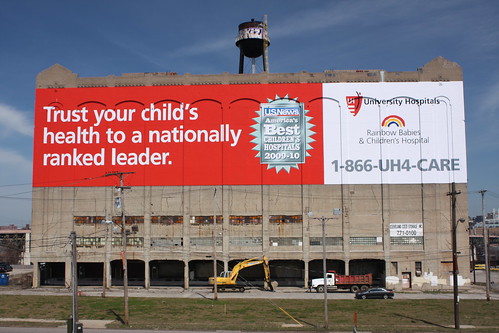
Cold Storage Building
Photograph by Thom Sheridan

The historic Cold Storage Building was added to the list on September 24. This will likely make it easier for ODOT to demolish the structure.


In future posts, I will address more of the structures on this list. Again, I appreciate any assistance you can provide in identifying those that are most historically significant.

Tuesday, October 5, 2010

The New Cuyahoga: A Proposal to Straighten the "Crooked River"

The name Cuyahoga is said to mean "Crooked River". Yet in the 1910s, there was a proposal to straighten the river, The New Cuyahoga: River Straightening Recommendations. This document was brought to my attention by Kevin Leeson, of the Cuyahoga County Planning Commission. The book is reproduced here from a copy in their collections, with the exception of the map below, which is used courtesy of Special Collections, Cleveland State University.


Image used courtesy of the Cleveland Memory Project, Michael Schwartz Library, Cleveland State University

The publication includes this folded map. (Note: a higher resolution version, as well as other maps of the river, are available as part of the Cuyahoga River Online Exhibition.) The blue represents the current course of the river, while the red represents the proposed realignment. Why would the Committee on River and Harbor Improvement of the Cleveland Chamber of Commerce, the author, suggest this? Why would they suggest the drastic change to something that was for a long time, one of the more graphically recognizable elements of our city?

In short, commerce. The report suggests that the difficulty of navigating the river made shipping to and from Cleveland more expensive, putting the port at a commercial disadvantage. Further, it was said that the project would provide relief from the flooding of the Flats, as had happened in 1904 and 1913. It suggests that the money saved by preventing floods would cover the cost of the river realignment. The authors add that it would open part of the upper Cuyahoga to industrial development.

A 1919 report, Conservancy and the Cuyahoga continues on the same train of thought.

It's unclear why these proposals remained mere proposals. The shape of the river remains an important part of Cleveland's history - from its founding to industrial growth to now, when we're using it for recreation - it's even a part of the Cleveland Area History logo.

There's no mention as to whether they planned to change the name of the river, once it was no longer "crooked".

Monday, October 4, 2010

Condemned Cleveland: A House on South Boulevard

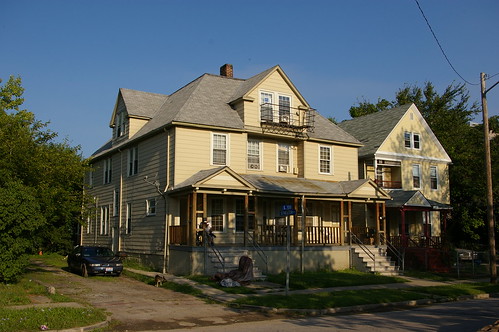
House in Wade Park neighborhood

A little while ago, I shared the list of structures condemened by the city of Cleveland in the past six months. I've been going through the list as I'm able, identifying the structures I that appear to be most historically or architecturally important.

It's a lot of structures. As of right now, the number is about 1200. And it's an imperfect science - I'm using Google Street View and Bing Maps to see what I can - but this is limited. Yes, I'd prefer to actually set my eyes on these properties, but I simply don't have the time. Further, I don't have a good list of which properties might be important for what happened in them.

Take a look at the list. See if there's anything in your neighborhood that you think is important. If you can get me photos of them, it would be much appreciated.


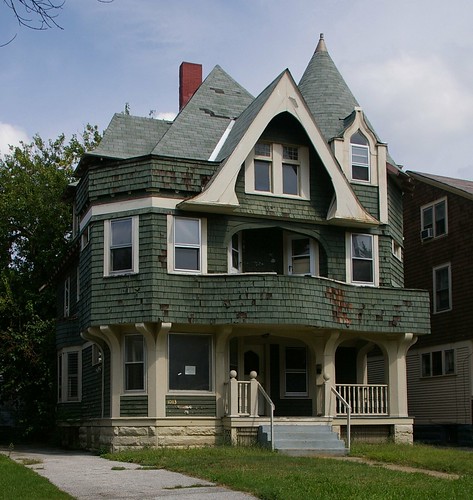
The lead photo is of 10113 South Boulevard, Cleveland, Ohio. It's one of the more interesting houses in the East Boulevard / Wade Park area - a neighborhood of eclectic homes. I wrote a story on it back in November - this was one of the houses included in that story.

The property was sold at Sheriff's Sale in July, 2008, to the mortgage holder, Wells Fargo Bank. Property taxes appear to not have been paid since that time. In December of that year, it was sold to the current owner, Ez Access Funding, LLC.

EZ Access Funding owns more than 70 properties within the city of Cleveland. As of September 30, they have been prohibited from transferring any property in Cleveland, for their failure to appear in court. (AFN: 201009300961)

EZ Access Funding, LLC is registered in California. Its mailing address is listed (by the California Secretary of State) as 3920 Birch Street, Suite 105, Newport Beach, CA, 92660. Their contact agent is one Marc R. Tow, a lawyer, whose mailing address is 3900 Birch Street, Suite 102, also in Newport Beach. Their phone numbers are 949-419-9093 and 949-975-0544, respectively.

This would be the same EZ Access funding who owns the house that exploded on West 83rd Street. Bill Callahan discusses their questionable business dealings in much more detail. Marc Tow / EZ Access were scheduled to appear in Housing Court back in February, to address several matters, including almost $100,000 in back taxes and an outstanding warrant, but to no one's surprise, they did not appear.

How much damage must an individual do before we can justify the cost of sending a bailiff cross country to serve them? Surely there must be something that we can do to address parties who, through apparent negligence, damage the historic structure of our communities and diminish our tax base.


This beautiful turn of the century house deserves a better owner. The architectural character contributes to the historic nature of the neighborhood.

East Boulevard is a great neighborhood - and I'm not just saying this because I work in it (at the Langston Hughes Branch of Cleveland Public Library). Surely this property could be sold at sheriff's sale to the city land bank - and then to the new owner - if there was someone interested in fixing it up. It's a great property - perhaps you are that person?

Check in on Wednesday for the next article in this series. Until then, take a look at the list and see if there is anything that catches your eye.

Update: October 5, 2010: I looked in the first floor windows. Through the front door, you can see a fireplace with built in benches on either side. To the left, one can see a doorway with a pair of pocket doors. To the right, just inside the door, is a small built-in bench. Next to it, the stairs up the the second floor. The woodwork is beautiful. It's the cleanest condemned house I've yet seen.

There are a few liabilities. I saw some damage to the plaster by the pocket doors (looked more like vandalism than a search for plumbing). The kitchen was a rather boring replacement - but in decent condition. The exterior did show some water issues, which appeared to be due to the lack of gutters and downspouts on the structure.

Friday, October 1, 2010

Mystery Photo for October 1, 2010

Jesse Owens house

Where is this house and why is it historically important?
Note that I have altered the street sign slightly, so you won't be able to tell based on that.

And we have a winner! This was the residence of Jesse Owens at the peak of his career, from 1934-1936. The house, still standing, is located at 2178 East 100th Street, in Cleveland, Ohio.

Be the first to identify it and win your choice of the following books:
  • Covering History: Revisiting Federal Art in Cleveland, 1933-43, a beautiful, 72 page joint publication of the Cleveland Artists Foundation and the Cleveland Public Library. It picks up where Karal Ann Marling's work (Federal Art in Cleveland) left off, and is highly recommended.
  • Any of the other publications of the Cleveland Artists Foundation that are still in print. The CAF is the organization publishing works on the history of art in greater Cleveland.
  • Shaker Heights Fences by Patricia J. Forgac (1984, 16 pages)
  • Shaker Heights: the Van Sweringen Influence by Claudia R. Boatwright (1983, 56 pages)
If you publish books or other products relating to Cleveland history and would like to offer them as prizes, please email clevelandareahistory@gmail.com