Friday, April 2, 2010

The Richard T. Coleman residence

Recently I visited 3050 West 14th St. in Cleveland, Ohio. One of Cleveland's famous historic architects, Charles Schweinfurth, designed this residence for Richard T. Coleman, who at the time was president of the Austin Powder Company. The permit to build this structure was submitted in August of 1889. Smith and Fish were listed as the builders.

According to The Encyclopedia of Cleveland History, the Austin Powder Company is the oldest manufacturing enterprise in Cleveland, founded in 1833 by the five Austin brothers. The explosives the company produced were used to blast rock for the canals being built at that time. Interestingly, when the brothers bought 1,200 acres and built a production facility in Glenwillow in 1892, they also built homes for its employees, a town hall, a school, and a general store, essentially forming the “company town” of Glenwillow. The Austin Powder company headquarters were originally located in the Rockefeller building in downtown Cleveland.

The Coleman family could only have lived in this house for approximately five years before they sold the home. They then moved up West 14th St. to 163 Jennings Avenue, which translates to #2307 where Grace Hospital now stands.

The home passed through the hands of a series of owners before William Dem (shortened from Demko) who lived next door in an Italianate where the gas station now sits, purchased the home in 1934. It stayed in the Dem family for 65 years until 1999, at which time William’s granddaughter sold it to a neighbor. The neighbor ran the home as a boarding house. After he passed away, the current owner Michele purchased the property.

Michele is very focused on the care and maintenance of the inside of the home, and it will be easy for you to see why.


Once you pass through the added on enclosed porch there are two interior doors. The first is a set of double doors.


The second is a very large Dutch door.


Through the Dutch door you will find a built-in sitting area to your left. Directly ahead is the main staircase.


The spandrel decorating the front staircase is undoubtedly the highlight of this home. The intricacy of the woodwork is unparalleled.


The owner has an old architecture advertisement featuring this type of fretwork. The ad is for C.S. Ransom & Company based in Cleveland that could have potentially produced this piece.


At the top of the stairwell you will find these prominent newel caps.


There are five fireplaces in the home.


The fireplace in the master bedroom has a cabinet that opens overhead for storage.


There is an asymmetrical fireplace on the second floor with decorative shelves on the left. This is extremely similar to the asymmetrical fireplace that Schweinfurth had in his own home.


Surprisingly there is a lot of storage including a butler's pantry and larger closets than what is typical for this time. There is also a room devoted specifically to built-in storage on the upstairs level.


There is a stationary window featured in the sunroom with decorative lattice woodwork in the upper pane.


The owner discovered in the dining room that the ceiling was once painted in a series of colors to possibly mimic a sunset with hues ranging from blue to orange-ish pink.


There are a series of small windows thought to serve as ventilation inlets. There are five in the attic, all of which are covered by the exterior siding. There are three on the second floor and one of those is covered.


On the first floor, exists what is believed to be an original powder room.


The exterior of the structure is a far cry from the original design as seen here in this 1919 Plain Dealer real estate ad.


You can however, see the original wood shingles at the top of the front of the exterior. The majority of the remainder of the structure is covered in siding.


The rectangular window on the upper level used to be an oval-shaped window with wooden accent pieces. Judging from historical photos, I believe it may have been replaced sometime between 1965 and 1976. The currently enclosed front porch was still open as late as 1976.


The wrought iron fence surrounding the property appears to be original.


There are some people who might say, "The interior of this house is stunning! Why not rip off the aluminum siding and bring the exterior to the same level of finish?" There's a big difference, however, between what we would like to do and what is actually possible with the time, funds, and energy that are available to us. The owner has done an incredible job with the interior of this house - it is truly an architectural treasure. The exterior of the house will come, eventually. The aluminum siding, while less than aesthetically perfect, is protecting the exterior until that time.

Thursday, April 1, 2010

Lustron: The House America's Been Waiting For

Lustron house

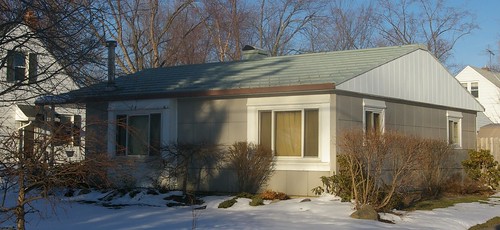
The Lustron house was a prefabricated enameled steel house made in Columbus, Ohio, between 1948 and 1950. The design was an attempt to repurpose factories left from the war effort and to address the post-war housing crisis. Approximately 2000 were made. Many were built in the Cleveland area.

Lustron house

All of the major component parts were made from steel - including the roof. Sadly, most have not held up as well as this model, at 695 McKinley Avenue, in Bedford, Ohio. Even it, however, has recently had replacement windows installed.

This house, documented by the Historic American Buildings Survey, provides some idea as to the original appearance of the interior. The rooms featured built in closets and cabinets, which provided greater use of the available floorspace.

Lustron house

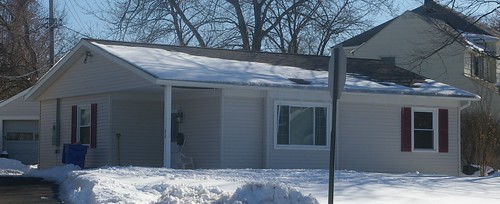
Four choices of exterior colors were available: blue, yellow, tan, and gray. Due to changing tastes, more than half of the Lustron houses in this area have since been vinyl-sided, such as this one, at 1517 Crestwood Road, in Mayfield Heights, Ohio. It seems likely that this is more the result of changes in taste than anything else - I have not seen one bit of rust on any of these houses, and if rust was such a problem that some owners vinyl-sided their houses to conceal it, it would surely show up to some extent those not vinyl-sided.

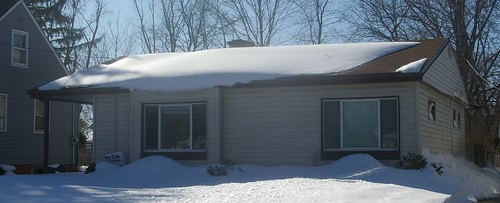
The roof, too, has been covered with asphalt shingles. It is not clear whether this was done to remedy a problem or due to changes in taste. It seems that a greater percentage of these houses have new roofs than have vinyl siding.

Lustron house
Many of the interiors have remained the same, as the steel structure makes them difficult to change. This one, however, at 1024 Mayfield Ridge Road, in Mayfield Heights, Ohio, has changed quite a bit. It is currently listed for sale by owner. The listing provides a detailed view of the interior.

These houses represent a significant point in our industrial growth and movement to the suburbs. The first enamel-steel house was built in South Euclid, by Ferro Corp. Later work in this field was based on that house.

Should we try to preserve all of these houses? No. We should work to preserve the best examples. One example would be this one, on Mastick Road in North Olmsted. It retains most of the original exterior details and looks quite sharp.

Further, we should identify all of the extant Lustron houses, so that if one is to be demolished, some of the parts, which are quite difficult to find, may be reused in other Lustron homes. Lustron Preservation has a database mapping all the known Lustrons, which provides a great deal of assistance, to that end.

Wednesday, March 31, 2010

Where does that staircase go?

Marine Hospital, Cleveland

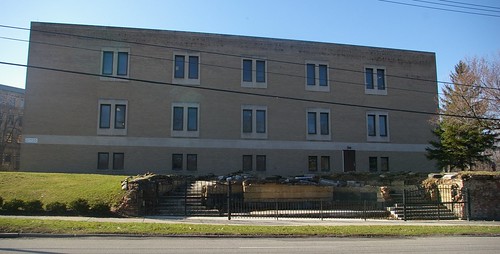
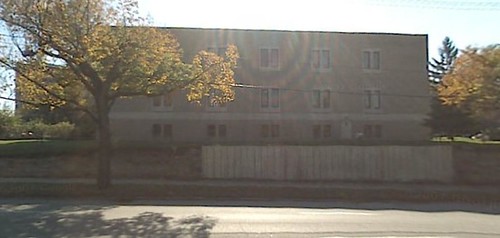
Perhaps you drive by the old Marine Hospital on Fairhill on your way to or from work. You may have noticed a wrought iron fence that appeared in front of a staircase and wondered what it is. I did - I was curious how this staircase related to the complex, which is a Cleveland Landmark.


Image courtesy of Google Maps

Until recently, this is what you would have seen from Fairhill - a concrete wall, presumably just a retaining wall.

The style of the staircase seems consistent with the rest of the complex, but if so, why was it buried? The postcard shown below may help to answer that question.


Image used courtesy of the Cleveland Memory Project

This illustrates the staircase as it was near the time that the complex was built, in the 1920s. It appears to form a sort of grand entrance to the complex.

What happened to the building shown here? Was it demolished? No, it is still standing. The building shown in the first photograph was built in front of it. This changed focus of the complex likely made the staircase from Fairhill unnecessary.

The recent excavation of the staircase helps tell part of the visual narrative of this complex. It makes the space more appealing from the street, too. The wrought iron fence was likely added as a safety measure.

Tuesday, March 30, 2010

Create Your Historic Cleveland Area Garden!

To celebrate my house's 100th birthday, I'm going to plant an heirloom garden stocked with flowers that might have been popular around the time my house was built in 1910. If you are interested in doing a bit of period gardening, here are some sources you may want to check out:

T
he New Traditional Garden : A Practical Guide to Creating and Restoring
Authentic American Gardens for Homes of All Ages by Michael Weishan (Ballantine Books, 1999).

This might not be the book you'd want to consult if your house was built during the 20th century (particularly the mid-20th century, as the author is pretty vocal about his disdain for 1950s architecture and landscape design). But for 19th century homes -- such as those in Ohio City -- The New Traditional Garden might be a good bet.


Restoring American Gardens: An Encyclopedia of Heirloom Ornamental Plants, 1640-1940
by Denise Wiles Adams (Timber Press, 2004).


To compile this comprehensive volume, Adams used a database of 25,000+ plants and hundreds of historic gardening catalogs to recreate 300 years' worth of American gardening trends.


Another good way to find historic gardening information is to look at books and magazines that were published around the time your house was built. Cleveland Public Library has numerous titles -- such as Better Homes and Gardens -- in print and on microfilm. Search the online catalog for the subject "gardening -- periodicals."

One of the best and most underutilized garden resources in Cleveland is the Eleanor Squire Library at the Cleveland Botanical Gardens. In addition to housing more than 16,000 volumes, the Eleanor Squire Library holds the distinction of being the first circulating horticultural library in in the country. Yes, that's right -- unlike many special libraries, you can actually check books out of the Eleanor Squire Library. (If you're a member, that is. And we highly recommend becoming a member.)

Cleveland may not be the happiest, richest, or best-educated city in the country, but darn it, it's a great place for people who love books -- I've lived in four different states, and let me tell you, we've got some of the best used bookstores in the country. Check out the selection of antiquarian gardening books at places like Loganberry Books and the $2 Rare Bookstore.

Or, if you don't feel like leaving home, don't overlook Google Books as a good source for historic gardening information. Use the Advanced Search to limit by date; simply type in "gardening" or "garden" as your generic search term. Depending on when your house was built, there should be at least a few books available for full or limited preview!

P.S. - I'm not too proud to admit that I'm not the world's best gardener. So if anyone wants to share gardening tips with me, I'm fair game!

Monday, March 29, 2010

The Luster Tannery

Luster Tannery

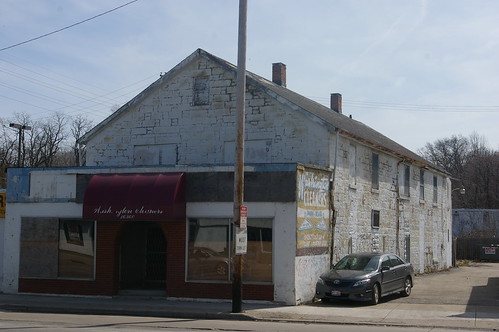
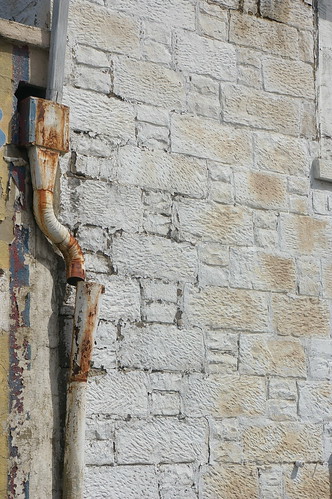
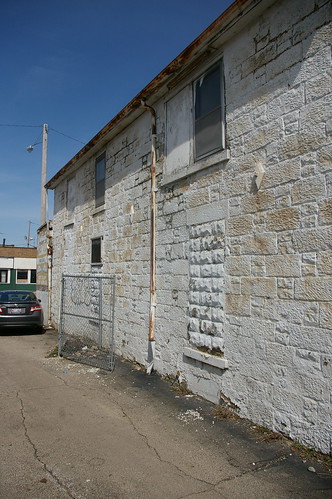
The other day, I came across this stone building at 16360 Euclid Avenue, on the border between East Cleveland and Cleveland, Ohio. I knew that this building was quite old, based on the way the stone appeared to have been worked by hand.
Luster Tannery

The tooling was similar to the tooling of the stone on the Rodolphus Edwards house and the John Honam house (the Old Stone House, in Lakewood).

I asked Roy Larick (of Bluestone Heights) and someone who has a particular interest in the historic geology of the region, and who has done considerable research into the Euclid Creek and Bluestone Heights area, about the house. I knew he'd be interested.

He was interested, but confessed that he hadn't been able to learn much about it. The only information he had, other than a couple maps, was this paragraph on page 10 of A History of East Cleveland by Ellen Loughry Price.

Sam Ruple and his family settled at Nine Mile Creek in 1805. The story is that the family had come from a Ten Mile Creek and considered this place a little less desirable than the old one-hence the name. He established a tannery there, later owned by the Luster family. The water from the creek was diverted into the basement vats of the stone house, and then out again into the creek. Mrs. Ruple fed a frightened run away squaw, and later fed and tried to delay a group of Indians in pursuit of her. But it was to no avail and they later returned with the captive.

I looked and looked into Samuel Ruple, with little luck. I came to the conclusion that he did come to the area at about the time specified and did own a considerable amount of land around Nine Mile Creek. However, no evidence other than this passage was found to suggest that they were involved in the tanning business. The Ruple family appears to have been primarily farmers, and well-to-do ones at that.

Plenty of evidence exists, however, documenting the Luster family as tanners, and operators of a tannery at this location. I believe that someone saw the tannery on the map, near the Ruple property, and connected the two.


Samuel and Susan Luster were probably both born in Canada, in 1800 or 1801. The 1900 Federal Census, however, states that they were born in France and Ireland, respectively. Their first child, Samuel S. Luster (henceforth Samuel, Jr., was born on September 19, 1823, in St. Thomas, Ontario. They moved to Euclid Township at some time before the birth of Catharine Luster, in 1830.

According to an obituary for Samuel, Jr., "As soon as the boy grew up he became a tanner and for many, many years, had a tannery on Nine Mile creek in Collamer." (Plain Dealer November 23, 1907, page 12). This would suggest that he became a tanner by the time he was 20 or so - 1843. It is not clear when he began to operate his own tannery.
Luster Tannery

Samuel Luster, Jr. purchased the land that the tannery is on, about 17 acres, from Levi and Sophia Billings in 1848 for $1,000. (AFN: 185101280004, 187010010001) The exact date of the construction of the tannery is unclear, but it was probably shortly after 1848. It has been stated that the tannery was built from stone cut on the farm. (Plain Dealer October 4, 1954, page 28) Given the geology of the land, this seems unlikely. The remainder of the 17 acres was used for farming. (Plain Dealer November 8, 1952, page 23)

The 1850 Federal Census, which lists Samuel, Jr. as a "Tanner and Currier". It also describes Samuel Luster as a farmer. It notes several other children, George (18), Sanbarah (15), Elizabeth (12), and Harriet (7).
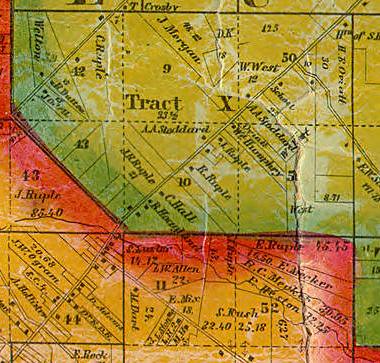


The 1858 Hopkins map of Cuyahoga County shows, about a third of the way from the bottom and a third of the way from the left, the property of S. Luster on Nine Mile Creek. It amounted to about 14 acres.


The detail on the map of Collamer shows a "Tannery and Shoe Shop by S. Lute". Given the similarity of the name to S. Luster, and because the County Recorder does not show any property transfers to anyone with the last name of Lute before 1927, we can safely assume that this was a typo for "S. Luster". The map shows the upstream extent of Luster's holdings, including quite a bit of Nine Mile Creek. It is unclear what the function of the other building on the property was.

The construction of the tannery tells us quite a bit about the state of Samuel, Jr.'s business. It would have been expensive and time consuming to build from stone instead of wood. Most of the places where we see buildings built from stone, it is because it is readily available. The use of stone suggests that the tannery business was either already doing quite well or that he wanted to create the impression of importance, and was able to put the necessary time and labor into this.

The 1860 Federal Census provides little new information. It lists Samuel Luster's occupation as "Master Tanner", owner of real estate worth $4,000 and personal property worth $2,000. The space for Samuel, Jr.'s occupation is blank. We can probably assume that they were working today running the farm, tannery, and possibly a leather-goods shop as well.

Samuel, Jr. and Helen Ellsworth Luster married in 1863. Helen's parents were from Vermont, originally. They remained in East Cleveland, where Samuel, Jr. built a house on the north side of Euclid Avenue, across the street from the First Presbyterian Church. (Plain Dealer October 4, 1954, page 28) This lot was purchased in 1866 from Henry Coit (AFN: 186605070006) and construction likely commenced shortly afterwords. Helen gave birth to 10 children, seven of whom were living as of 1900.

Samuel Luster died in 1867, and was buried in East Cleveland (Township?) Cemetery. Susan Luster likely died between 1860 and 1870. The exact date is unknown.

In 1870, we have the first explicit statement that Samuel, Jr.'s occupation was as a tanner. (1870 Federal Census)
Possibly the Luster vineyard, East Cleveland

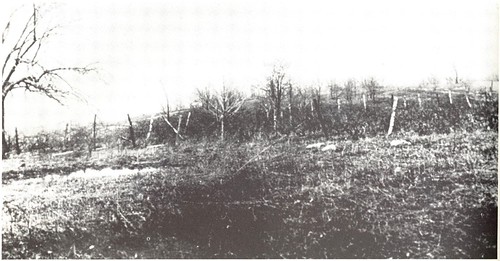
In 1870, for $604.50, Samuel, Jr. purchased 18 acres of land from Agnes McDonald and Flora and John Parker. (AFN: 187007120007) He used the land, on Noble Road, as a vineyard. This site is now part of Nela Park. Neighboring farmers also grew grapes. The "Abandoned Vineyard", photographed in 1911 on the site of what became Nela Park may have been that of the Luster family. (A History of East Cleveland by Ellen Loughry Price, page 60)
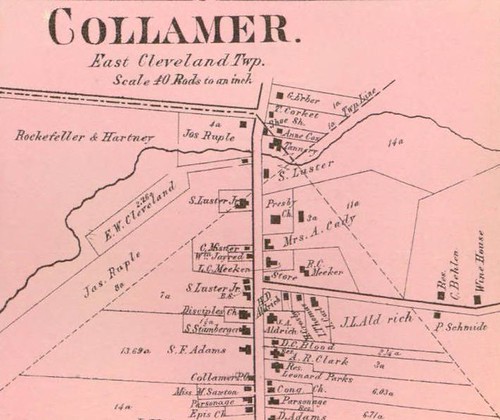


This 1874 map shows the Luster house, tannery, and farm, though not their vineyard, which would be just off the right edge of the page, on the north side of the road. Neither the tannery nor the vineyard are listed in the business directory for this map.

A building, owned by S. Luster, is shown on the plate covering the southern half of Euclid, in the 1892 Atlas of Cuyahoga County and Cleveland, Ohio, though it is not mentioned as a tannery.

The 1900 Census lists their address as 4277 Euclid Avenue, in East Cleveland. This is presumably the house facing the First Presbyterian Church. Samuel, Jr. and Helen had retired. Six of their children were still living with them. Burt Luster, born November, 1864, was a farmer. Ernest Luster, born March, 1869, was a carpenter. Ellen Luster, born August, 1871, was a teacher. May Bell Luster, born February, 1875, was a teacher. Blanch E. Luster, born July, 1877, was a also a teacher. No occupation was listed for Pearl I. Luster, born July, 1879. It was noted that "In later years, he [Samuel, Jr.] retired to his farm and lived quietly." (Plain Dealer November 23, 1907, page 12)

The 1903 Maps of Cuyahoga County outside Cleveland shows Ellen Luster owning the farmhouse opposite the First Presbyterian Church. It also shows the land that the tannery sits on being owned by S. Luster.

Helen Ellsworth Luster died on the evening of Friday, October 29, 1905. The listing states that her residence was in South Euclid, but I believe this to be an error. The funeral was held in the residence on the following Monday at 2 pm.

Samuel Luster, Jr. died from heart-related problems on the morning of Friday, November 22, 1907 in his residence in East Cleveland. (Plain Dealer November 23, 1907, page 12) The funeral was held the following Monday at 1 pm in his residence. He was buried in East Cleveland Cemetery. The Cleveland Necrology File lists the address as 14277, which is incorrect. I suspect this was an error, based on the pre-1905 address of 4277. The obituary describes him as a "pioneer tanner" and notes that at the time, he was the second oldest person in East Cleveland. It further noted that he was survived by five children: Bertram E. Luster of Euclid; and Ernest Luster; Mrs. C.W. Dille; Mrs. Norman Parks; and Mrs. W.W. Herron, all of East Cleveland.

The Luster farmhouse was owned by E.W. Luster, as shown on the 1914 Plat Book of Cuyahoga County. There was a second house, next door, by that time.

It is unclear when this structure last functioned as a tannery and became home to some other business.
Luster Tannery

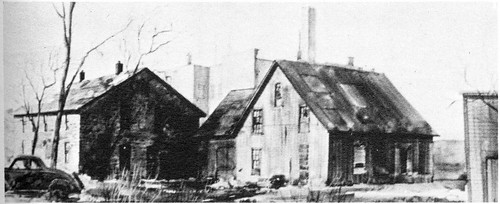
This image of the "Tannery at 9 Mile Creek" was published in A History of East Cleveland by Ellen Loughry Price (page 21). Based on the automobile, the photo was taken during or after the 1930s. This view illustrates the south side of the tannery, now obscured by an addition, and another building, in the center of the photograph, which was also part of the tannery complex. The facade of the building shown here also provides us some clues as to what the side facing the street might have looked like. If the original photograph could be located, it would provide a wealth of valuable information.


To summarize: This tannery was built by the Luster family as a tannery, between 1848 and 1858. It was likely built into the hillside, so that "The water from the creek was diverted into the basement vats of the stone house, and then out again into the creek." The land surrounding the tannery was used as a farm, which, combined, provided sufficient revenue to purchase additional land in 1870, which was used as a vineyard.

The tannery is unique. There simply aren't other stone commercial or industrial buildings of this vintage in the county. It is also special because of its size - the only stone buildings here of this vintage bigger than it are a few churches.

This article is the first time, other than the brief mention in the paragraph cited above, that any mention of this building has been published in the last 50 years, and the first time anything more than a sentence or two has been written on it.


Luster Tannery

The question now is as to what happens next.

Taxes have not been paid on the Cleveland portion of the building since 1999, and on the East Cleveland portion since 2004. They amount to about $30,000. This would seem to coincide with a sale of the property to Immaculate Dry Cleaners. (AFN: 200401291006) The associated document states that Immaculate Dry Cleaners is incorporated in Ohio, and lists the president and contact agent as one John Iverson. The Secretary of State does not list any filings for a business under that name or with that individual as a contact. Given all this and that the building is boarded up, it seems safe to assume that, if it is to be saved, we must be the ones who act.

This building appears to be in reasonably good condition, all things considered. Check out the full set of photographs of it and think of its potential. That the windows have been filled in is probably to our advantage, as it has afforded the interior some protection.

This property is unlike any other in the area. It represents a significant point in the growth of Cleveland from a rural town to an industrial giant. There are few buildings representing early midsize industry. We need to evaluate the interior of this one and figure out how we can reuse it to catalyze the rebirth of this community and of Nine Mile Creek.

Last updated:
March 29, 2010, 6:30 pm: Corrected amount owed in back taxes to $30,000, from $20,000.
March 29, 2010, 12:15 pm: Added information about Collamer detail on 1858 Hopkins map
April 7, 2010, 1:45 pm: Added 1930s photo and accompanying text