Showing posts with label preservation. Show all posts

Tuesday, December 6, 2011

New Blog Content In Search Of Preservation-related Questions

I would like to take a moment and introduce myself to the readership of Cleveland Area History:

My name is Jessica Ugarte, and I am an enthusiastic new resident of the Cleveland area. I am also a preservationist at the Cleveland Restoration Society, with both Bachelor of Arts and Master of Science degrees in the field of historic preservation. Through a combination of classroom studies and preservation-related employment I have had the opportunity to be involved in stabilizing and restoring many different types of built culture. Over the past decade I have worked on projects like repairing the interior plaster of a 1920s theater, leading a project to stabilize an important 1890s home shortly after Hurricane Katrina, participating in the restoration of a 1910 steam locomotive engine, and heading a project for the National Park Service to stabilize and repair marble funerary monuments on remote islands on the Outer Banks. While I haven’t seen or worked on it all (yet), my years of focus on material conservation and science usually enables me to have a good idea of what needs to be done and even how to do it.

Cleveland Area History has asked me to start writing a regular column on this website where I will be answering reader questions about the materials, deterioration, repair, and even construction of their older or historic Cleveland-area buildings.
But in order for this to get started, I need to hear from you! Please email your inquiries along with your name, phone number, the property address and an image if possible to: jugarte@clevelandrestoration.org.
You can send me old building-related questions like “how do I repair a historic wood window,” “why do I see what looks like chunks of chalk in my home’s mortar,” “what is the best way to clean and restore a clear finish on historic wood” or even “so what’s the big deal with using vinyl siding on a historic home?”

While I promise to respond to all requests for information and assist in any way possible, not all questions and answers will be able to be posted here on Cleveland Area History. Additionally, depending on your particular question and needs, a more in-depth follow-up may be required.

I look forward to hearing from Cleveland Area History’s readers and finding out what questions may be on their minds.

Thank you!

Jessica Ugarte is employed by the Cleveland Restoration Society, a nonprofit that uses the powerful tool of historic preservation to revitalize our diverse communities, strengthen the regional economy, and enhance the quality of life in northeastern Ohio. www.clevelandrestoration.org

Tuesday, December 15, 2009

Why we must be the ones preserving old buildings

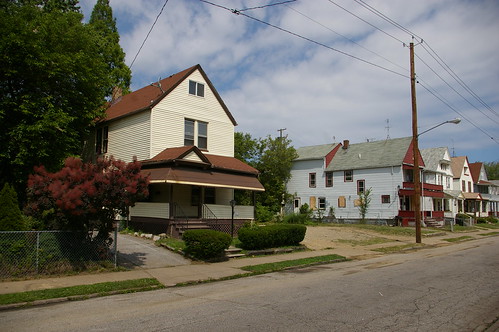
I had a conversation recently that was quite illuminating. Jay Gardner, Community Development Director at Fairfax Renaissance Development Corporation showed me through the Langston Hughes house at 2266 East 86th Street and explained their plans for the house.

The approximate cost of the renovation would be $70,000-$90,000. Gardner explained that this includes replacing the plumbing, wiring, furnace, new roof, and major work in the kitchen and bathroom. It also includes replacing the plaster with drywall, as it has significant damage in some places. He further explained that while the railing and bannister would be retained, the trim would probably be replaced with new trim milled to match the existing. They also planned to remove the vinyl siding and address the wood siding underneath it. If it needed serious work, it would be replaced with Hardie Board.

At this point, I began to feel uncomfortable. With all these details were removed, what would remain of this historic house? Mr. Gardner explained that the trim and walls had to be addressed one way or another, because of lead paint issues. Further, stripping lead paint from woodwork is time and labor intensive, and therefore expensive. Fairfax Renaissance can't afford to lose huge amounts of money for the sake of historical perfection.

The same arguments can be made with regard to the removal of the plaster and the replacement of the siding.

Do I like this? No. Is there any other way? No. Fairfax Renaissance is trying to be historically sensitive. They're doing their best to maintain historical integrity while still keeping these houses at prices that people can afford. They're doing better than 95%+ of the people rehabbing houses in the city, and for that, I respect them.

It's simply too labor intensive for anyone other than an individual to rehab a house to the standards we'd like to see upheld. If you've ever spent time stripping paint off of woodwork or doing some other detail job on an old house, you know this to be true. While commercial rehabbers should be held to a certain standard, there's just no way they can do the level of detail work that we'd like to see.

There's a very big upside to this. It means that if you're willing to pour a ton of labor into one of these old houses, you can live someplace truly incredible, without a huge outlay of cash. This is especially true in the greater Cleveland area, where there are many houses with a lot of potential at bargain basement prices.

We always talk about how we'd like to see this or that house saved, with the hope that someone will do it. "Someone" isn't good enough. If we can't, for whatever reason, save these houses ourselves, we need to actively work to find people who can. If there's a house on your street or in your neighborhood that deserves to be saved, talk with your neighbors and figure out a way to work with them to bring it back from the brink.

We have to save these houses. No one else can afford to.

Thursday, November 26, 2009

Preservation and the Medical Mart

No discussion of Cleveland history and preservation would be complete without mentioning the debacle over MMPI’s new -- and unexpected -- proposal to build the Medical Mart north of Mall C.

This is not an issue that Cleveland preservationists are taking lightly. In her letter to the editor in the November 22 Plain Dealer, Cleveland Restoration Society director Kathleen Crowther made it clear that the view of Lake Erie visible from Mall C has become an essential part of the Cleveland skyline, and that perhaps we should use existing vacant properties before building new ones. And Steven Litt’s story in today’s PD says it all: “MMPI plan for medical mart may be best for the company, but not the best for Cleveland."

The editors at Cleveland Area History can hardly agree more. We are puzzled by how MMPI could apparently have failed to budget for extensive upgrades to the 87-year-old Public Auditorium’s plumbing, mechanical, and electrical systems. Or how they could be surprised that people might get mad about the new proposal: like Councilman Mike Polensek, we are suspicious that MMPI’s sudden abandonment of Public Auditorium amounts to little more than a bait-and-switch.

Perhaps most of all, we are chagrined (but not surprised) at the latest installment in what might be Cleveland’s greatest talent: misallocating public money toward the questionable panacea of monument-building. Convention centers simply don’t deliver the economic benefits that their proponents endlessly tout. We can’t help but wish that the $333,333 a month that Cuyahoga County taxpayers are shelling out to MMPI would go toward our numerous struggling cultural institutions instead.

Some will argue that we have to at least try to bring business to Cleveland. We agree. Conventions, however, are not the means to that end - there are plenty of cities with great convention centers, and there doesn't seem to be the demand for another. Further, we simply don't have the climate to make for a desirable convention site.

The worst part of this whole mess is the site. The Mall is the most significant green space in downtown Cleveland. Putting the center north of Mall C would permanently mar the landscape. It's one thing for us to throw away money, it's another to throw away one of the most valuable pieces of public real estate.

Thursday, November 12, 2009

Langston Hughes house revisited

Langston Hughes residence

There was a nice article on Cleveland.com today about the Fairfax Renaissance Development Corporation's possible plans to rehab the Langston Hughes residence at 2266 East 86th Street. I'm only mentioned as "a local librarian", but that's fine with me - I'm just glad to see that the house won't be demolished.

I've posted a set of lots of photos of the Langston Hughes House at 2266 E. 86th St. if you want to see it in more detail.