Showing posts with label Cleveland Artists Foundation. Show all posts

Tuesday, May 29, 2012

Mystery Painting: I.T. Frary

Mill by a River
[Mill by a River]. An oil painting (1899). Used courtesy of a private Cleveland area collector.

Ages ago, when I began assembling material for the exhibition I curated for the Cleveland Artists Foundation on the life and work of I.T. Frary, I asked if you, my readers, might have some of his paintings in your collections.

The exhibition, Designing History: I.T. Frary; Interior Design and the Beginnings of Historic Preservation in Ohio traced Frary's career, from his beginnings in art school, through the work that he did as an artist and interior designer, to his landmark book, Early Homes of Ohio, published in 1936, which remains the best general work on historic architecture in this state. Smith House, Adams Mills, Ohio
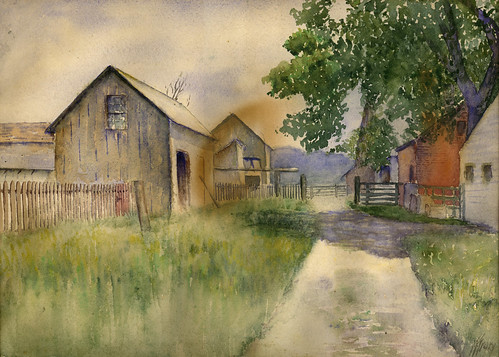
Smith House, Adams Mills, Ohio A watercolor painting (1904). From the collection of Jim Oswald.

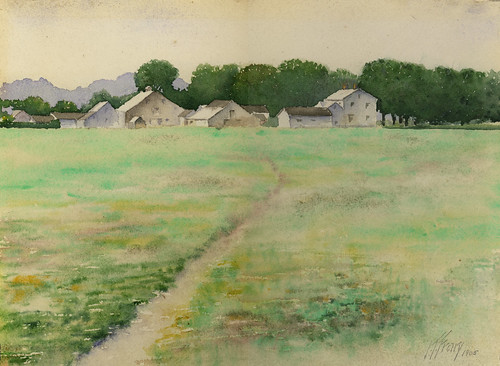
A couple great watercolor paintings had remained in the Frary family.
H.A. Smith House, Adams Mills
H.A. Smith House, Adams Mills A watercolor painting (1905). From the collection of Jim Oswald.

They depict the landscape in Adams Mills, in Muskingum County, Ohio, where Frary's wife's family lived. Zoar
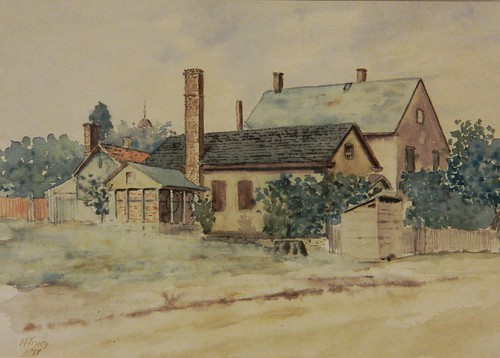
Zoar A watercolor painting (1898). Collection of the Cleveland Artists Foundation..

Another watercolor, the only one in private hands outside the Frary family, depicts a scene in Zoar, Ohio. It is now in the collections of the Cleveland Artists Foundation. Frary made the painting while a student of F.C. Gottwald.


Still, I knew that there had to be more of his paintings out there. Frary had exhibited dozens, at the least - and they were good paintings. They couldn't have all disappeared, could they? Mill by a River
[Mill by a River]. An oil painting (1899). Used courtesy of a private Cleveland area collector.

Then, a few months ago, I received and email from a private collector, who had purchased this oil painting at an estate sale years ago. It's the first oil painting that I've found by Frary - and I can't figure out where the scene is! We know that I.T. Frary painted in the vicinity of Zoar, Chagrin Falls, and Adams Mills, Ohio. Could it be one of these, or possibly something in the vicinity of Cleveland? What do you see?
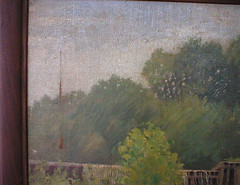
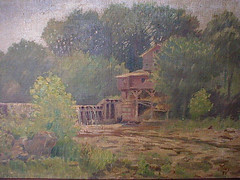
Mill by a River Mill by a River
[Mill by a River]. An oil painting (1899). Used courtesy of a private Cleveland area collector.

Here are a couple details, with the hope that they may help in the identification of the piece.

Tuesday, June 7, 2011

Interior Design and the Illuminating Company: A Group of Paintings by I.T. Frary

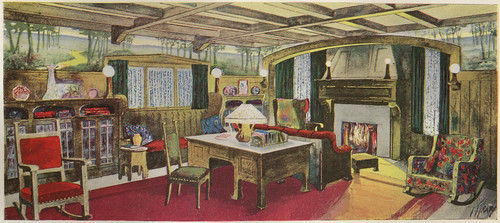
A Living Room in the Style of the Modern English School
Living Room in the Style of the Modern English School, a painting by I.T. Frary, reproduced in The Illuminator, June, 1909. Collection of Western Reserve Historical Society, Cleveland, Ohio.

I'm curating an exhibit for the Cleveland Artists Foundation, Designing History: I.T. Frary; Interior Design and the Beginnings of Historic Preservation in Ohio. Frary is best known as the author of Early Homes of Ohio, the first book to address this state's architectural heritage. His first career was as a designer of furniture and interiors for the Brooks Household Art Co. Brooks became one half of the famed Rorimer-Brooks.

As I mentioned before, one of the challenges is finding strong imagery other than his photographs - especially color imagery. (I'm still looking, by the way, if the signature seems familar.)

[Living Room]
[Living Room] a painting by I.T. Frary, reproduced in The Illuminator, June, 1909. Collection of Western Reserve Historical Society, Cleveland, Ohio.

I was pleasantly surprised to find, in the I.T. Frary Papers at the Western Reserve Historical Society, a copy of The Illuminator, dated June, 1909. The magazine was published for the employees of the illuminating company, and used several of Frary's paintings for the Brooks Household Art Co. to illustrate a piece on various interior design ideas.

[Colonial Style Hallway] [Hallway]
[Colonial Style Hallway] and [Hallway], paintings by I.T. Frary, reproduced in The Illuminator, June, 1909. Collection of Western Reserve Historical Society, Cleveland, Ohio.

This pair illustrate two very different ways that one might treat an entrance hall. The Colonial Style one, on the left, is far more formal, while the one on the right is more casual.

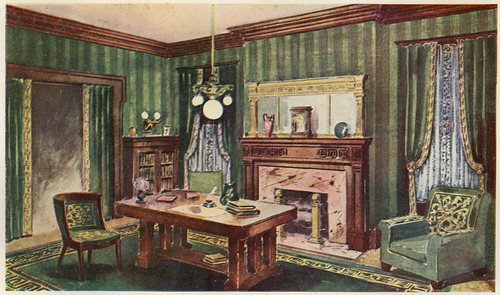
A Living Room in the Style of the Greek Revival
Living Room in the Style of the Greek Revival, a painting by I.T. Frary, reproduced in The Illuminator, June, 1909. Collection of Western Reserve Historical Society, Cleveland, Ohio.

This view, Living Room in the Style of the Greek Revival, like the lead image, Living Room in the Style of the Modern English School, illustrates the level of detail that Frary, as a designer, might put into a room. Some of the furniture would have been his designs, while other elements would be carefully selected antiques.


It's not clear where the houses in these renderings were located, or even if they were built. Given the number, I would guess that at least one had been executed. However, the firm's commissions in Cleveland were almost entirely on Euclid Avenue, and so are likely lost. I'll delve further into the Brooks Household Art Co.'s commissions in a future post.

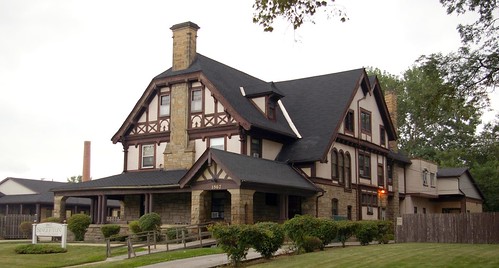
Edwin Tillotson residence

The Edwin Tillotson residence is a Tudor Revival structure at 1867 East 82nd Street, in Cleveland, Ohio. It was built in 1902-3. Meade and Garfield were the architects.

The Tillotson residence is one of the few remaining local structures for which the Brooks Household Art Co. did work. Perhaps Living Room in the Style of the Modern English School was for this house - or perhaps it was for one in Chicago or St. Louis. I haven't had a chance to look inside yet - but I suspect that it has been significantly modified over the years. Still, it's worth further investigation.

Do any of these look familar to you?


The exhibition Designing History: I.T. Frary; Interior Design and the Beginnings of Historic Preservation in Ohio runs through July 16. I encourage you to take a look. The Cleveland Artists Foundation is located at 17801 Detroit Avenue, in Lakewood, Ohio.

Wednesday, February 2, 2011

Assembling a Museum Exhibit - I Need Your Help!

The Life and Works of I.T. Frary

I'm working on an exhibit for the Cleveland Artists Foundation on I.T. (Ihna Thayer) Frary, scheduled for June and July of this year.

I.T. Frary is best known as an author and photographer. His works include the classic Early Homes of Ohio, as well as Thomas Jefferson: Architect and Builder, Early American Doorways, They Built the Capitol, and Ohio in Homespun and Calico.

Frary was born in Cleveland and attended the Cleveland School of Art (now the Cleveland Institute of Art). He was chief designer at Brooks Household Art Co., and later a desiger at Rorimer-Brooks. Following this, he worked as an independent designer. He went to Texas for a YMCA position during World War I. On returning to Cleveland, he worked at the Cleveland Museum of Art, as Membership and Publicity Secretary. During this time, he wrote and spoke extensively on the architectural heritage of this area. He was on a national advisory board for the Historic American Buildings Survey, and is part of the reason why they were able to locate and document so many significant structures in this area. After retiring, he moved to Winter Park, Florida.

Frary exhibited his design sketches with the Cleveland Architectural Club and his other paintings in group shows with members of the Cleveland School, in the 1890s through 1910s. Later, his photographs would be included in major museum exhitions, including the Thomas Jefferson Bicentennial Exhibition at the National Gallery of Art and The Greek Revival in the United States, at the Metropolitan Museum of Art. This is a list of the exhibitions that Ihna Thayer Frary was a part of or that I strongly suspect he was a part of.

I've researched Frary extensively in the collections of the Western Reserve Historical Society and the Ohio Historical Society.

I'm writing this with the hope that you can help me locate graphical materials relating to I.T. Frary.

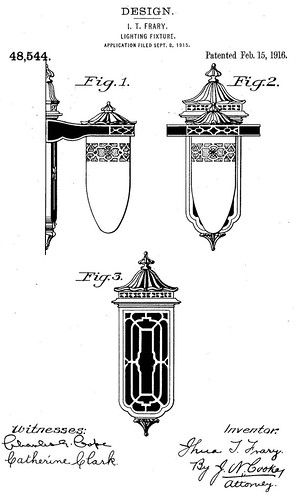
Design for a Lighting Fixture

The following are but some of the things that I'd be interested in finding:
  • Items designed/produced by the Brooks Otis Household Art Co. or the Brooks Household Art Co.
  • Items designed by Rorimer-Brooks before about 1915. (Note: it would have been spelled Rorheimer-Brooks at the time.)
  • Any of four items designed for the Hocking Glass Co. 1, 2, 3, 4.
  • A tile fireplace designed for Rookwood Pottery's Architectural Division, project number A403
  • Any paintings or drawings created by Frary.
  • Any photographs or personal materials relating to him and his work.
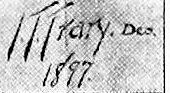
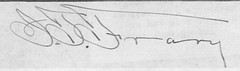
Renaissance Hall Mantel Frary002 Note that Frary's signature wasn't always the most ledgible. Here are two examples, one from 1897, at left, from this design sketch and one from c. 1935, at right. I've seen several editorial cartoons from c. 1910 signed merely "Frary", so this might be expected.

Again, I appreciate any assistance you might be able to offer any materials you might be willing to loan. Please contact me directly at ClevelandAreaHistory@gmail.com

Monday, August 9, 2010

Book review: Cleveland Goes Modern

I've been wanting to review Cleveland Goes Modern: Design for the Home, 1930-1970 for quite some time. The book, published by the Cleveland Artists Foundation in 2007, documents what they believe to be the best in modern residential architecture in the greater Cleveland Area.

An essay on mid-century modernism by Ted Sande provides some context to the architecture illustrated in the book. Six architects receive more in-depth looks at their work: Don Hisaka; John Terence Kelly; Robert A. Little; William B. Morris; Ernst Payer; and Fred S. Toguchi. Eighteen others receive brief overviews, a third of a page in length. An essay, by Henry H. Hawley, on decorative arts during the same period contributes to a better understanding of the aesthetic of the architecture.

Generally, I agree with the residences chosen for inclusion. The Agnes Gund residence, designed by Don Hisaka, which graces the cover, is stunning. So is Hisaka's own residence, which I featured back in December. Similarly, John Terence Kelly's McDonald residence deserves to be here, as does the Harold Burdick residence.

There are some issues with the title. It only includes architect-designed homes, so structures like the Ferro House, in South Euclid, are excluded. They played a significant role in the exploration of new materials that mid-century modern came to embody. The book also only includes houses that were still standing at the time of publication. One that we've lost, which would have been worthy of inclusion was the house that Ernst Payer designed for Peter Lloyd on South Woodland in Moreland Hills.

The biggest flaw, however, was the failure to include the addresses of the houses. When we talk about historic sites, we need to be able to talk about where they are. Further, historians need to know where structures are to know if they are still standing as well as to talk about historical context.

There is a remedy to this oversight. This PDF is a two page appendix that should have been published with the book. It lists the addresses for every house pictured in Cleveland Goes Modern.

With this addition, I highly recommend Cleveland Goes Modern. It presents and interesting perspective on a period in Cleveland residential architecture that has not been previously addressed. The photographs illustrate interiors of many homes that I'll never be able to see - heck, given these locations, there are many that I won't ever even be able to see the exteriors of in person. While I don't agree completely with the decisions and choices, it's more a matter of academic disagreement than actual flaws.

Cleveland Goes Modern: Design for the Home 1930-1970 was published in 2007 by the Cleveland Artists Foundation. 48 pages. ISBN: 978-0-9799739-0-1. It may be purchased from the CAF store or in person at CAF, at Beck Center, in Lakewood.

Wednesday, February 10, 2010

Book review: Yet Still We Rise


One of the most important publications of the Cleveland Artists Foundation is Yet Still We Rise: African American Art in Cleveland 1920-1970. The 1996 exhibition opened at the Cleveland State University Art Gallery and then traveled to the Butler Institute of American Art in Youngstown and the Riffe Gallery in Columbus.

The exhibition catalogue discusses African American art in Cleveland and provides national context. It also includes brief (usually about a page) biographies of most of the artists included in the show. The artists covered include Edith Brown, Elmer W. Brown, James T. Brown, Malcolm W. Brown, George Bryant, Fred Carlo, Lewis and Andrew Chesnutt, Allen E. Cole, William W. Crawford, Matthew Dunlop, James "Jimmy" Gayle, Harold Louis Golden, Charles Elmer Harris (a.k.a. Beni E. Kosh), Josephus Hicks, Charles Ingram, Zell (Rozelle) Ingram, Hughie Lee-Smith, Virgie Paton-Ezelle, Clarence Perkins, Douglas Phillips, Charles Jackson Pinkney, Charles Louis Sallée, William E. Smith, Ernest William Trotter, Henry Williamson, and W. Hall Workman.

The book, quite simply, is the best source on African American art in Cleveland.

WorldCat lists 59 library systems as owning copies of the book - more than twice as many as the next most popular Cleveland Artists Foundation publication. The 1996 catalog has long been out of print. The asking price for Yet Still We Rise has climbed such - now usually $50-150 - that I've considered selling my own copy. The copy listed on Amazon.com right now at $11 is an outlier and a great deal.

Why do I make a point of the rarity of the title? As part of the 2009 exhibition Each in Their Own Voice: African-American Artists in Cleveland, 1970-2005, the catalogue for Yet Still We Rise: African American Art in Cleveland 1920-1970 was scanned and made available. The 165mb PDF may be downloaded from the Cleveland State University Art Gallery website. The Cleveland Memory Project features interviews of some of the artists involved in Each in Their Own Voice as well as photographs of some of the artworks.