Or, Why We Need to Retain Historic Houses as Part of Our Communities
In the past few months, I've raised a louder voice for preservation of buildings relating to historic individuals and events. As a result, I've seen many different suggestions as to things that we should be doing instead of preserving these buildings.
Some have suggested that photographic documentation is enough. Others have have suggested that a given building isn't worth saving because it wasn't where the individual created their most important works. Still others have suggested that the individual's achievements would be better commemorated by a statue. One even suggested, in a letter to the editor of the Plain Dealer, on Wednesday, that we should deconstruct the Langston Hughes house and re-use the lumber to build a community center.
I'm a youth services librarian in the inner city. In my experience, when you talk about overarching historical themes, you get a lot of blank looks. But when you can talk about important individuals who lived in their neighborhoods, who walked the same streets as they walk every day, it's possible to make a real connection.
It's not enough to just show photographs of a house that once existed. There's an importance that actual artifacts have that simply isn't conveyed in photographic reproductions. We aren't content with a museum exhibit of photographs of Satchel Paige's baseball uniform or Langston Hughes' manuscript poetry - we demand the real thing.
Many important individuals have come out of Cleveland - individuals that the children I serve can look up to. We tell them that these historic figures are worthy of respect and admiration, that they are people the children can look up to, but then we demolish what little remains of these great people's physical connection to the city. What message does this send?
As I've said before, I don't believe that these houses should be made into museums. I just think that they should be preserved as part of the community. There are plenty of historic houses that remain private residences - take the John Heisman birthplace or the Jeremiah Gates residence, the oldest house in Cleveland.
It's our collective fault that some of these houses have been allowed to decay to this point. We failed to bring them to the public attention when they needed less work. There are plenty of homes throughout the area that individuals and companies are in the process of rehabilitating, either as their own residences, or with the intent of resale. It costs a lot of money to demolish a house - $10,000 plus - wouldn't a more appropriate expenditure of the public money be to put that expense into the rehabilitation of the structures? $10,000 would often be enough to make the difference between a house that can be rehabbed in a cost effective manner and one that cannot.
Why should the public pay for any part of the rehabbing of a private residence? Because, while not open to the public, these houses are part of our history. The cost of fixing up any one of them to museum standards, with proper accessiblity, mechanical, and fire suppression systems would likely cost a half million dollars. This hypothetical sum might instead be divided over 25 houses, to the tune of $20,000 each. It would stabilize 25 sites important to the history of our community, and would provide the public a greater value than one small museum.
It's not about public vs. private funds, however. It's about a respect for the history of our city. It's about showing our children that we care about their past. It's about showing that the figures we claim matter actually matter to us.
Showing posts with label historical markers. Show all posts
Showing posts with label historical markers. Show all posts
Friday, September 3, 2010

Sunday, August 8, 2010
A Bit of Legal History: The Founding of the Ohio State Bar Association
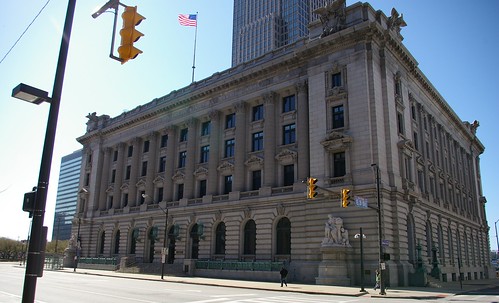
Sometimes, historical markers are massive, freestanding objects, obvious to all passersby. But just as often, they are small, inconspicuous plaques, commemorating small and large pieces of our history. They can be hidden in plain sight and barely be noticed.
This is the Howard M. Metzenbaum United States Courthouse, known to some of us as the United States Post Office, Court House, and Custom House. (This would be the same "some of us" who refer to the baseball stadium as Jacobs Field.) It is located at 201 Superior Avenue, N.E., in downtown Cleveland.
See the small dark spot on the building, just to the right of the pole with the traffic signals? It's a historical marker. Here's a close-up:
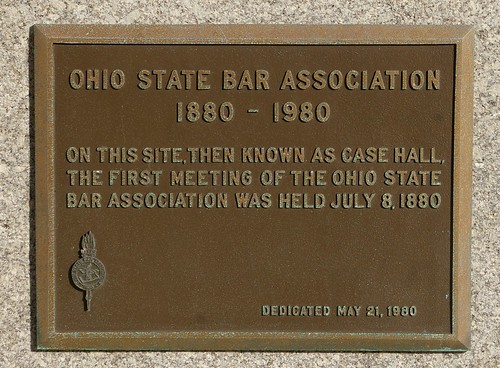
It reads:
Ohio State Bar Association
1880-1980
On this site, then known as Case Hall, the first meeting of the Ohio State Bar Association was held July 8, 1880.
Dedicated May 21, 1980.
Case Hall, built in 1867, was a popular gathering place. It featured an auditorium, and for a time, housed Cleveland's city hall. It was demolished to make way for the courthouse.
Monday, April 19, 2010
Fort Huntington
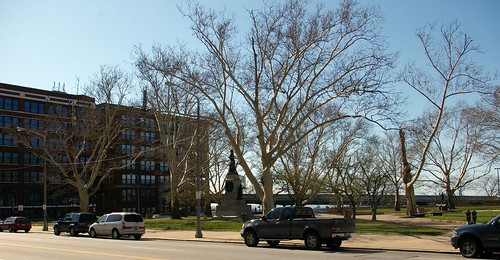
Have you ever driven past this park on Lakeside Avenue in downtown Cleveland, between Ontario and West 3rd Street?
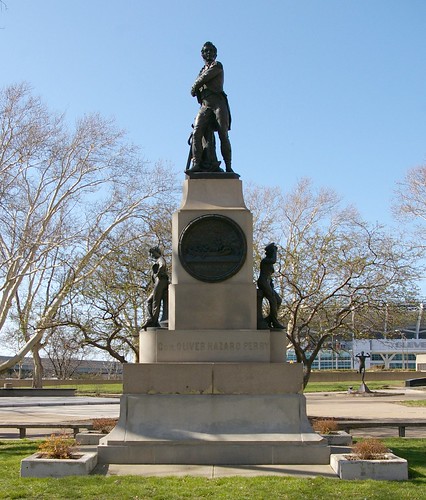
You probably noticed this statue, erected to the memory of Commodore Oliver Hazard Perry and the role he played in the defense of the United States in the Battle of Lake Erie, during the War of 1812. A brief inscription on the reverse describes his accomplishment. This is not just another statue in a city park - this site is significant.
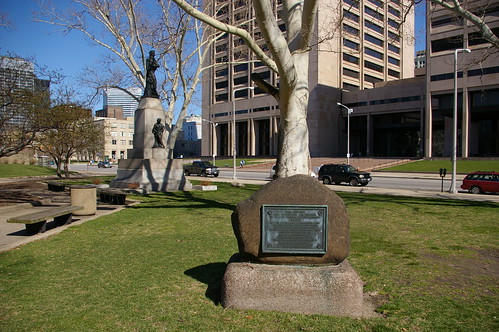
Near the Perry statue is a historical marker, identifying this land as part of Fort Huntington. The text reads:
Near this site Fort Huntington was erected by Captain Stanton Sholes' Company May, 1813.
On June 19, 1813, a part of the British fleet appeared off the fort but was drived away by a storm and no attack was made. General William Henry Harrison and the staff inspected the fort July, 1813.
Erected by the National Society United States Daughters of 1812, Commodore Perry Chapter, Cleveland, Ohio.
Marked on the 125th anniversary of the founding of Cleveland, A.D. 1921. Hon. W.S. Fitzgerald, mayor.
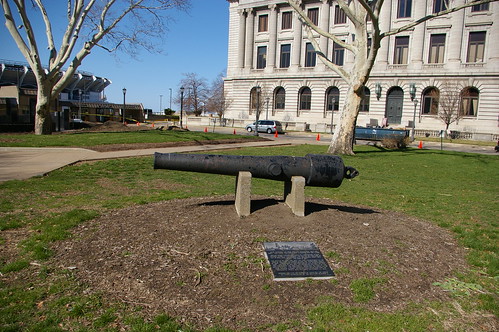
A canon captured from the British fleet during the Battle of Lake Erie has been placed nearby.
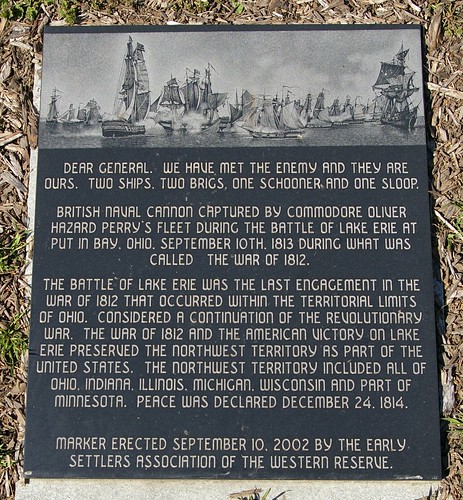
The cannon is accompanied by this stone marker, installed in 2002 by the Early Settlers Association of the Western Reserve, describing its history and the significance of the Battle of Lake Erie and the War of 1812.
Another marker, erected on the Navy Bicentennial, in 1975, also commemorates the Battle of Lake Erie. Nearby stands a statue of Jesse Owens. The park also contains a memorial to the Cleveland Peace Officers who died in the line of duty.
So while this park may seem like just another city park, filled with monuments to various persons and groups, it is more than that. It is the site of Fort Huntington, a garrison built to defend this settlement from foreign invasion.
Monday, February 1, 2010
Garrett Morgan, Cleveland Inventor
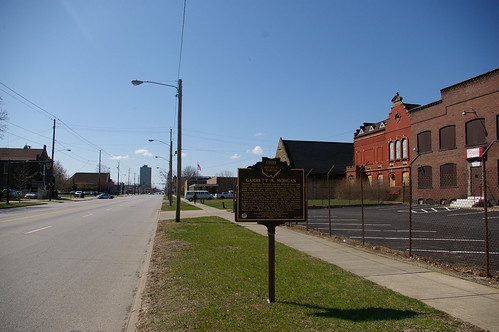
A historical marker on East 55th Street, just south of Harlem Avenue, commemorates the life of African American inventor Garrett Morgan. The text reads:
Garrett Augustus Morgan was an African American businessman and prolific inventor of devices that made people's lives safer and more convenient. Born on March 4, 1877 in Claysville, the Black segregated section of Paris, Kentucky, Morgan migrated north first to Cincinnati and then Cleveland in 1895. He lived and worked in this house at 5204 Harlem Avenue. In 1906, Morgan started the G.A. Morgan Hair Refining Company to market the hair straightener he had invented. The following year he opened a sewing machine repair shop. In 1908, he and his wife Mary opened Morgan's Cut Rate Ladies Clothing Store.
In 1910, Garrett Morgan invented the curve-toothed hair-straightening comb, and four years later patented the safety hood, the forerunner of the gas mask used in the 1916 Lake Erie Crib disaster and further developed and used in World War I. He also invented the traffic signal and sold his patented rights to General Electric Company. He was a founding member of the Cleveland Association of Colored Men and served as treasurer. He continued to invent tools, gadgets, and devices well into his 70s. He died in 1963 while preparing an exhibition of his life's work for an exposition in Chicago.

The marker refers to his home, at 5204 Harlem Avenue. He is shown in it in this 1960 photograph, used courtesy of the Cleveland Memory Project. The house was demolished in the 1980s or 1990s.
Monday, December 7, 2009
Missing: Charles W. Chesnutt historical marker
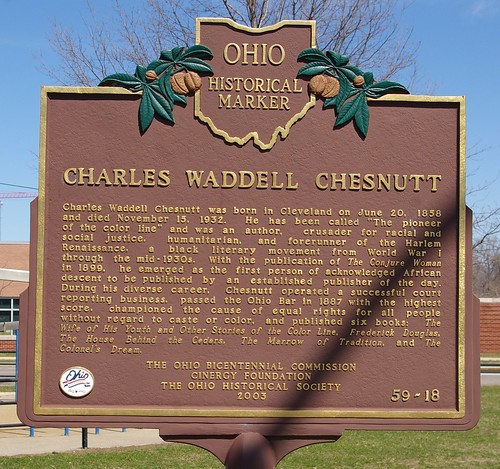
The other day, on my way to work, I noticed that this historical marker was missing. On further investigation this morning, I saw a hole in the ground where the marker post had been, further suggesting that the marker had been stolen, probably for scrap metal value, rather than removed from its post for repairs. I contacted the Ohio Historical Society, which admisters the program, and they said that they have no record of the marker being removed for maintenance.
The marker, which was placed on Lamont Avenue at East 100th Street, read:
Charles Waddell Chesnutt was born in Cleveland on June 30, 1858 and died November 15, 1932. He has been called "The pioneer of the color line" and was an author, crusader for racial and social justice, humanitarian, and forerunner of the Harlem Renaissance, a black literary movement from World War I through the mid-1930s. With the publication of The Conjure Woman in 1899, he emerged as the first person of acknowledged African descent to be published by an established publisher of the day. During his diverse career, Chesnutt operated a successful court reporting business, passed the Ohio Bar in 1887 with the highest score, championed the cause of equal rights for all people without regard to caste or color, and published six books: The Wife of His Youth and Other Stories of the Color Line, Frederick Douglas, The House Behind the Cedars, The Marrow of Tradition, and The Colonel's Dream.
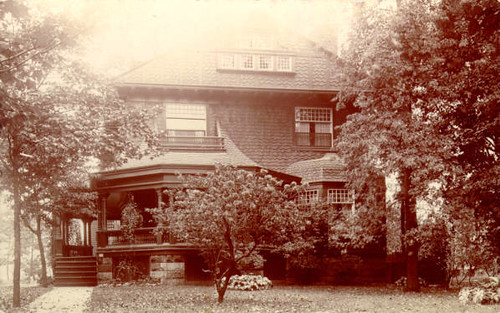
Chesnutt lived in this house, at 9717 Lamont Avenue, from 1904 until his death in 1932. It is just down the street from the site of the historical marker. It was demolished to make way for Charles Orr elementary school. The Cleveland Public Library has a collection of photographs relating to Chesnutt, his life, and this house.
Chesnutt's previous residence, 64 Brenton Street, (now 2212 East 73rd) was his home from 1888-1904. It has also been demolished.
My usual tendency is to be more concerned about preserving historic sites than erecting markers once buildings have been demolished. I've come to realize that we've lost so many sites important to the history of the Cleveland area that the only way we can share the history of our neighborhoods, in some cases, is to memorialize what has been lost. In this case, this means installing a new historical marker.
According to the OHS pricelist a replacement marker will cost about $2,000. There are some that will argue the money might be better spent on other things within the neighborhood. To this I respond that we have to illustrate the history and potential of neighborhoods in order to make people want to live in them.
Subscribe to:
Posts (Atom)